

When an Event Is Over, the Real Work Begins
By TESS HAYES ’25
In 2015, the late Pope Francis published an encyclical titled: Laudato Si’: On Care for Our Common Home. The encyclical teaches that everything is connected: harm to the environment is harm to the poor, and throwing away food while others go hungry is a moral failure. It urges Catholics to practice “integral ecology,” the care for both people and planet, through everyday actions such as reducing waste, sharing resources, and building community.
In 2022, Saint Mary’s College began a seven-year commitment, in an effort to address any climate damage that impacts campus, students, and the broader South Bend community. Since 2014, Saint Mary’s has rescued roughly 30,000 pounds of edible food. Ten years ago Saint Mary’s became the first college in Indiana to launch a Food Recovery Network chapter.
The Problem:
Have you ever attended/hosted a catered event where your guests didn’t consume the amount of food or drink you anticipated? And none of your guests wanted to take leftovers home? This is a tale as old as time.
The Solution:
This year, thanks to a generous grant from the Raskob Foundation for Catholic Activities, Inc., a brand-new program at Saint Mary’s recovers food from lectures, receptions, gallery talks, and department meetings; the new Food Waste Recovery program shines light on possible solutions to this issue.
“It’s one of the most direct ways our students put Laudato Si’ into action and practice their Catholic faith,” says Maria Gonzalez-Diaz, sustainability coordinator in the Center for Faith, Action, and Ministry (CFAM). Quoting paragraph 50 of the encyclical, “Pope Francis talks about how throwing away food is like stealing food off the table of the poor. Every night, our volunteers are literally preventing that theft, one tray at a time,” Gonzalez-Diaz said.
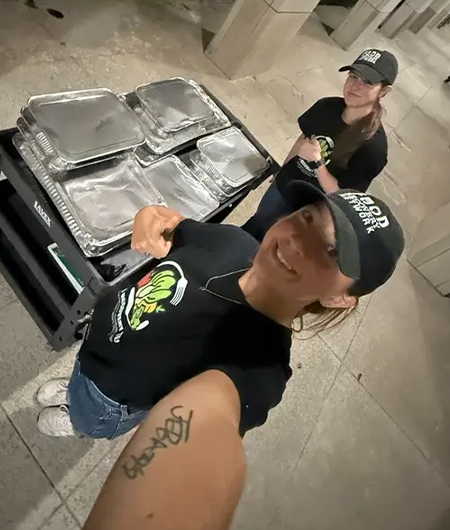
For juniors Josie Baggs ’27 and Hannah Teich ’27, Laudato Si’ is not just something to read, but something that inspires action. Baggs, a nursing major from Ames, Iowa, and Teich, a theology and religious studies major from Tucson, Arizona, are certified food handlers and have spent time building relationships with the families who eat the food they rescue, all thanks to the opportunities CFAM provides students.
The process is simple: campus event organizers with 35 or more people fill out the online Food Recovery Request Form. Baggs and Teich arrive 15–30minutes before the end of the event, wearing Food Recovery uniforms. They weigh and label every pan, and deliver it to For the Good, a South Bend nonprofit directed by Campus Minister, Carrie Badertscher. Thanks to the Raskob grant, if Baggs and Teich are unable to make a same-day delivery, the food is stored in a brand-new industrial refrigerator, which is located in the basement of Le Mans, as well as a new cart ready for transferring.
This semester alone, the recovery program has rescued 236.9 pounds from catered events. One recovery still makes them smile: 84.5 pounds from a single event was enough to feed 10 families.
“My favorite part so far has been weighing the food and seeing how much we have recovered,” Teich says. Their spring goal? “More than 25 food recoveries next semester!”
For Baggs, this is faith-based work: “This is a very tangible representation of being concerned for people as well as God’s creation by minimizing our waste while demonstrating dignity to the families we serve. Even the smallest, consistent acts of care for God’s world can create positive ripples in a community.”
Baggs and Teich believe the program is not just about food, but about relationships. “It’s about blurring the lines between our campus and the South Bend community,” Baggs explained. “Instead of seeing ourselves as separate spaces, this work brings us together in a shared mission of care and solidarity. Each food recovery process is a very simple yet faithful way to demonstrate our love for others through both our time and our resources.”
Gonzalez-Diaz sees in Baggs and Teich the living heartbeat of Saint Mary’s Catholic identity. “They keep me hopeful,” she says. “On days when the broader climate news feels overwhelming, I watch these two show up with energy and joy and I remember why I do this work. Josie’s enthusiasm is contagious; Hannah’s depth makes me go back and reread Laudato Si’ with fresh eyes.”
Quoting the encyclical again, Gonzalez-Diaz said: “We must regain the conviction that we need one another, that we have a shared responsibility for others and the world, and that being good and decent are worth it.”
Even if an event planner forgets to request a recovery, Baggs and Teich still show up if they can. And if they can’t, Gonzalez-Diaz will drop everything to rescue food herself if the students are in class. The recovery team hopes that anyone on campus planning an event will fill out the Food Recovery Request Form. It is why, in the words of Laudato Si’, “all creatures are connected, each must be cherished with love and respect, for all of us as living creatures are dependent on one another” (LS 42).
December 16, 2025