

Faculty Profiles
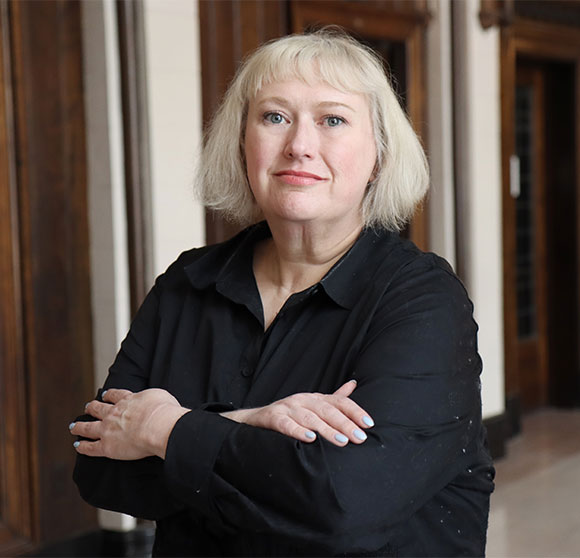
Jennifer Broome
“I’m for truth, no matter who tells it." —Malcolm X
The nature of my current occupation (teaching undergraduates), prior experience (teaching in high schools, a graduate program, and community college), and past coursework in English education have afforded me some excellent opportunities to survey the field. From Adler to Zimmerman, I've read, studied, discussed, and had professionals guide me through texts about how and why to teach. And yet…after almost 20 years, it's still a challenge to provide an 'elevator pitch' of who I am as a teacher. I can say for certain that I have taught urban, rural, and suburban students; poor and middle class students; and students of various ethnicities, languages, and countries of origin. I have taught 14 year olds and 50 year olds. I have taught courses from 9th grade English all the way to graduate seminars. Throughout it all I have remained as the constant.
How do I begin to explain all this teaching, except as a series of paradoxes? I must meet students where they are yet push them beyond their own expectations. I am expected to render the abstruse into the apparent; reframe both the simple and the complex; and transform what was obvious into the unfamiliar. At once a source of expertise and a perpetual learner, my teaching is a collaborative, dynamic process that involves a complex integration of imagination, skill, ethics, content knowledge, and the willingness to take risks in every lesson for the sake of my students.
My Instructional Metanarrative:
At the base of every lesson, project, assessment, and course I teach is the question, "Who benefits?" This orientation towards curriculum design comes from William Pinar and Madeleine Grumet’s work on Reconceptualist theory, specifically through their text Towards a Poor Curriculum (Pinar and Grumet, 2014). In this book, Pinar and Grumet argue for a less technocratic view of curricula development in favor of development that is more philosophical, epistemological, phenomenological, and aesthetic in nature.
Indeed, Pinar advocates for currere instead of curricula. He asserts that curriculum must be viewed as a cognate of currere; in other words, as a verb. Literally the Latin infinitive “to run,” currere is invoked to describe the process of inward journey or learning that is at the heart of teaching (ibid). Rather than lists of behavioral objectives or books to teach, currere focuses on the acts involved in teaching and learning, particularly those that relate to both intellectual and ethical development. Focusing on the benefit that can accrue to students through the lesson is my alpha and my omega.
Instructional Goals and Objectives
The next aspect of my teaching design involves instructional goals and objectives. Some instructional goals are technical in nature, it is true; what is important in a linguistics section may not be useful in a literature survey course. However, I have a set of general objectives that are vital to any group of students I teach. I call this list my “Non-negotiables” and it includes the following:
I shall work to help students…
1. Discover ideas in the course that excite, enthuse, scare, and intrigue them
2. Practice tenacity
3. Embrace productive failure; value the drafting and revision process
4. Become autodidacts
5. Value education as an end worth pursuing, not just a means to credentialing
6. Develop an individual writerly voice
7. Write in an academic register and provide reasonable, logical, and validated evidence for their claims
I shall provide students…
1. Space to practice self-teaching and peer-teaching
2. Multiple opportunities and methods of assessment
3. Tools for reading critically and the space to practice critique
4. Opportunities to read aesthetically as well as efferently
5. Consistent, individualized feedback on each draft/revision of their writing
6. The opportunity to take intellectual risks
7. A classroom where the instructor admits her errors and strives to correct them
Pedagogical Strategies:
I further subject the “how” of teaching, the individual strategies, to much thought. My pedagogy is based on experience, reading research, receiving coaching from outstanding mentors, and an archive of daily reflections on my practice. Broadly, I employ reader response theory, structured seminars, and a writers’ workshop model.
Reader response theory was pioneered by Rosenblatt (1995) and owes something to Bakhtin’s (1981) theories of dialogic speech. Generally, this process emphasizes the role of the reader’s understanding of the text’s meanings. It guides discussion of texts by using a recursive process to help students construct an understanding of how their identities, experiences, and self-concept influence their reading of the text. Acknowledging the transactional nature of reading allows students to open themselves to critical receptions of the text that are different than their own.
Seminars are a major focus of any class I teach. The nature of a structured seminar requires students to (a) prepare by closely reading and re-reading a text; (b) engage in academic dialogue with peers; (c) exercise appropriate social cues, including active listening; (d) enter into response with their peers who are leading the seminar; (e) assume responsibility for their learning; (f) use multiple communicative modalities to engage with a text. Seminars are graded as tests with clear expectations for preparation, speaking, and listening factored equally into the grade. As well, I as the instructor am responsible for ensuring all relevant points are covered when the seminar leaders can’t. Helping students develop the tools to successfully complete a seminar is a time-intensive task and requires
practice. Any time I wonder if the time investment is worth it, I recall the inevitable moment when the class asks me to sit outside the circle and debrief them at the end. That is the moment when they have fully taken control of their own learning.
Finally, I am a firm proponent of the writing workshop model. Good writing is not sui generis; drafting and revision are central to the production of cohesive, logical writing. I am committed to using digital technology and cloud-based computing to assist during the workshop process. Programs like Google Drive and Evernote can capture revision histories; allow simultaneous editing of a document during a writing conference; help students avoid plagiarism; and give me an opportunity to provide real-time substantive feedback outside of class hours. I use the workshop model to help students maintain longitudinal portfolios of their writing. These portfolios assist students in evaluating their growth and refining their skills from course to course and year to year. I regularly provide exemplars in a genre and work with students to analyze what goes into an outstanding piece of writing in the genre they are attempting. The use of self-assessments and structured peer assessments of students’ writing is an integral part of the process as well.
The Wisdom of Polonius
There is still so much I wish to explain, to question, to countermand in what I have written. As I grow as an educator, a researcher, a reader, and a writer, my ideas will be refined; some will be replaced with newer, better methodologies. Currently, my class design seeks to guide students towards transformative educational experiences that provide both challenge and multiple modalities for success. I am not sure what my classroom will look like in ten years—the research on which I base it may not yet be written. Through it all, I maintain a fidelity to instructional objectives and pedagogies that work for my students. My favorite education professor was probably accurate when she declared that though my teaching “…be madness, yet there is method in it.”
- Bakhtin, M. M. (1981). “Discourse in the novel” (C. Emerson & M. Holquist, Trans.). In M. Holquist (Ed.), The Dialogic Imagination: Four Essays by M.M. Bakhtin (pp. 259-422). Austin: University of Texas Press.
- Pinar, W. F., & Grumet, M. R. (2014). Towards a Poor Curriculum. (3rd ed.) Kingston, NY: Educator’s International Press.
- Rosenblatt, L. (1995). Literature as Exploration. (5th ed.) New York: Modern Language Association.
Ph.D., New York University
M.Ed., University of North Carolina at Greensboro
B.A.,University of North Carolina at Greensboro
- Educational document analysis
- Teaching pedagogy
- Philosophy and Education
- Educational documents
- Foucault and education
- Teachers' views on curriculum and instruction
- EDUC 201: Foundations/Teaching in a Multicultural Society
- EDUC 345: Curriculum and Assessment in the Middle and High School
- EDUC 346: Literacy Strategies and Classroom Management
- EDUC 447: Teaching English in the Middle and High School
- Associate Professor of Education, Saint Mary’s College, Notre Dame, IN (2024-present)
- Associate Professor of Education (tenured), Methodist University, Fayetteville, NC (2016-2024)
- Chair of Education Department, Methodist University, Fayetteville, NC (2016-2024)
- ENG 112 instructor for nontraditional college students, including emerging bilingual populations, Durham Technical Community College, Durham, NC (2015-16)
- ENG 111 and ENG 112 instructor for high school students through the Career and College Promise program, Johnston Community College, Smithfield, NC (2015-2016)
- SAT/ACT instructor, Wake Technical Community College, Raleigh, NC (2015-2016)
- Head of School and Cognitive Development instructor (NB: Longleaf is a public charter high school.) Longleaf School of the Arts, Raleigh, NC (2013-2015)
- English I, Independent Inquiry, English III, and AP Language & Composition instructor (NB: Gray Stone is a public charter high school) Gray Stone Day School, Misenheimer, NC (2009-2013)
- Area II instructor, Area III instructor, Head Counselor, North Carolina Governor's School, Raleigh, NC (2001-2012)
- SAT Instructor; question writer for the company's New SAT book; author of an introductory grammar module for the company. The Princeton Review, Chapel Hill, NC (1998-2005)
- Instructor; courses taught include English II, Honors English II, English III, Honors English III, Advanced Placement Literature & Composition, and SAT. Dudley High School, Greensboro, NC (2001-2005)
- “Fatphobia, Foucault, and Resistance in the English Classroom” Peer-reviewed book chapter in press, 2026.
- “Doubleplusungood: Moms for Liberty, book banning, and the use of Orwell’s Newspeak.” Peer-reviewed presentation at the American Association of Teaching and Curriculum annual conference, 2025.
- Hunkins Distinguished Article Award Lecture, “The Dialogic Dilemma: Pacing Guides as Objects of Analysis” (presented at American Association of Teaching and Curriculum annual conference), 2021
- Broome, J. (2020). “The Dialogic Dilemma: Pacing Guides as Objects of Analysis” Curriculum and Teaching Dialogue, 77-90.
- “Race Conscious Classroom Management: New Methods in Instruction of Undergraduate Students.” Presentation at the American Association of Teaching and Curriculum annual conference, 2023.
- “The Case for High School Philosophy Courses” (article published in the North Carolina Association of Gifted and Talented teacher newsletter), 2022.
- American Association of Teaching and Curriculum
- American Educational Research Association
- Association for Supervision & Curriculum Development
- Indiana Council of Teachers of English
- National Association for Gifted Children
- National Council of Teachers of English
- North Carolina Teaching Fellows (alumna)
- Phi Beta Kappa