

Be a Weaver of Hope
Dear Saint Mary’s Friends,
As we enter Thanksgiving week, I find myself thinking about gratitude in a much larger context than that of an American holiday with complex origins. I just returned from Washington, DC, where I was privileged to be part of an invitational summit made up of 20 presidents, hosted by the Association of Catholic Colleges and Universities (ACCU) and Georgetown University’s Initiative on Catholic Social Thought and Public Life. The summit focused on a deep engagement with Pope Leo XIV’s Magnifica Humanitas (MH) and its implications for higher education. We heard from remarkable speakers, celebrated Mass together, and spent time in meaningful discussions. I’m grateful to have been part of this gathering.
In preparation for the meeting, I read and re-read the encyclical, in which the pontiff explores how “In the era of artificial intelligence, when human dignity is threatened by new forms of dehumanization, ours is the pressing duty to remain profoundly human” (MH §15). Throughout the document, he uses the concept of building a new city together, and he implores Catholics, Christians, and all people of good will to construct a civilization of love. He insists that each of us is “called to assume an active role” in that project, and he ultimately expresses confidence that individual actions make a difference. In his conclusion, he muses that “the construction site appears to be already up and running, thanks especially to the many living stones solidly united to Christ the cornerstone” (MH §236). But it is clear that there is still much work ahead.
Perhaps one of the most important lessons of Magnifica Humanitas is that the future we build depends on embracing our humanity more fully, not transcending it. Moreover, we must acknowledge that our humanity encompasses our creativity, knowledge and skills—as well as our limitations, interdependence, and capacity for compassion and love.
As those of us working in higher education know, we have a special responsibility to form a new generation and to prepare our graduates to be architects and builders of this renewed civilization. The summit at Georgetown offered an opportunity for leaders of Catholic colleges and universities to consider how we can—in our unique contexts—maintain and deepen the culture of encounter we foster. We wrestled with how we can find new ways to help students make their campus a home—a place where they experience ideas and people who challenge them, where they learn to use AI as "a valuable tool that requires vigilance" (MH §100), and, perhaps most importantly, where they develop the capacity to relate to one another in unmediated ways. In these encounters, they strengthen their commitment to justice and the common good.
I see this happening at Saint Mary’s, and I am thankful for the students who choose to attend our College, eager for new experiences. I also appreciate the faculty and staff who accompany them as they walk into their adult lives with gratitude for the gifts they have been given. Yet in this moment when AI promises something that seems to exceed human limitations, I also take to heart Pope Leo’s reminder that “humanity flourishes not despite limitations, but often through them” (MH §118). By acknowledging our finitude and our failures, we can all discover and enhance our compassion, our wisdom, and our true relationships across our journeys. In interrogating the assumption that the development of a superhuman AI necessarily represents technological progress, Pope Leo observes: “True progress always stems from a heart open to others, an intelligence willing to listen and a will that seeks what unites rather than what separates” (MH §15).
Toward the end of Magnifica Humanitas, Pope Leo offers a series of small and easily actionable ways that each of us can do our part in what might seem like the overwhelming project of building a civilization of love. I believe these practices can provide a foundation for the kind of community we seek to build at Saint Mary’s: being “mindful of our words”; building “peace through justice”; taking a stand and amplifying the voices of victims; cultivating “a healthy realism” that “does not give up on changing the world”; and engaging “in dialogue and. . . authentic encounters with others, with those who are different, strangers and migrants” (MH §§ 214-219). If we practice these values in our community, we can expand outward through concentric circles of impact.
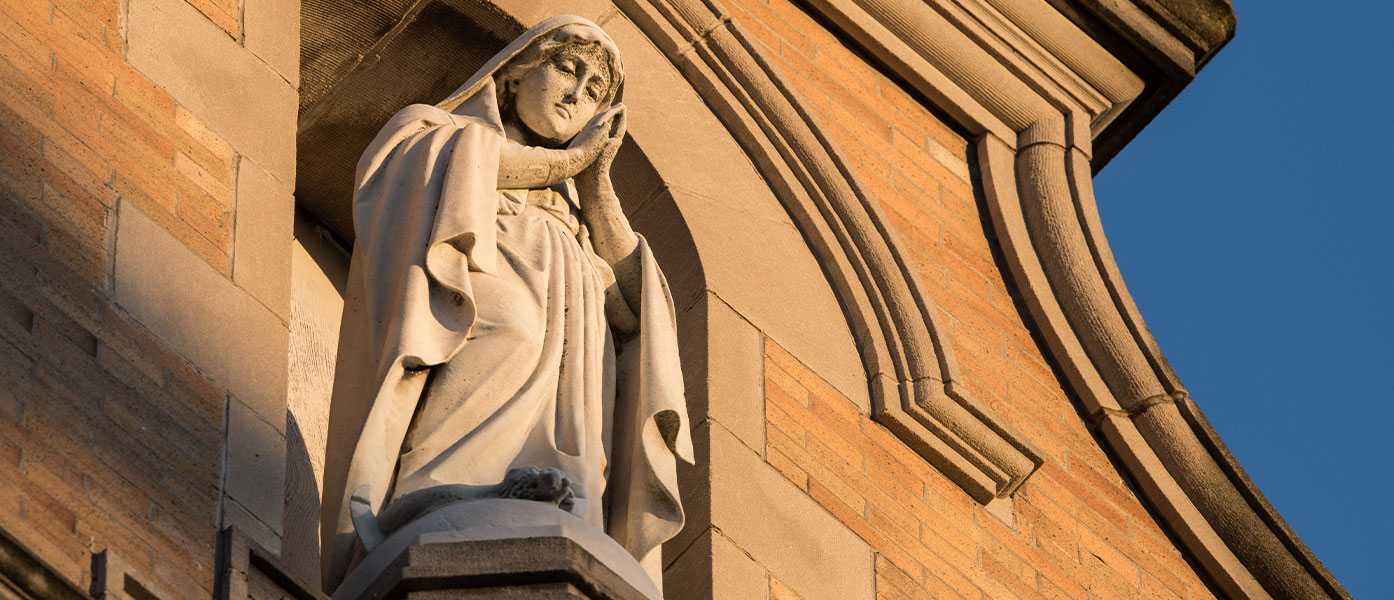
With a spirit of gratitude for what we have and a humility about what we can accomplish, we can also look to the namesake of our college: Mary, Mother of God. In closing his encyclical, Pope Leo invokes Mary, a poor and unprepared girl, who offers the prayer we now know as the Magnificat when she says “yes” to God’s plan. He calls her prayer “the song of hope.” She invites us, he says, to “become ‘weavers of hope’ in our world, sharing who we are and what we have” (MH §§243-245).
I hope for each of us a Thanksgiving table that is a space for that kind of sharing: a place where we are grateful for the gifts we have received, make room for others and recognize their humanity, and renew our hope in what we can build together.
Warm regards,
Katie Conboy, Ph.D.
President
November 24, 2026