

Great Expectations, Great Archives
By TESS HAYES ’25
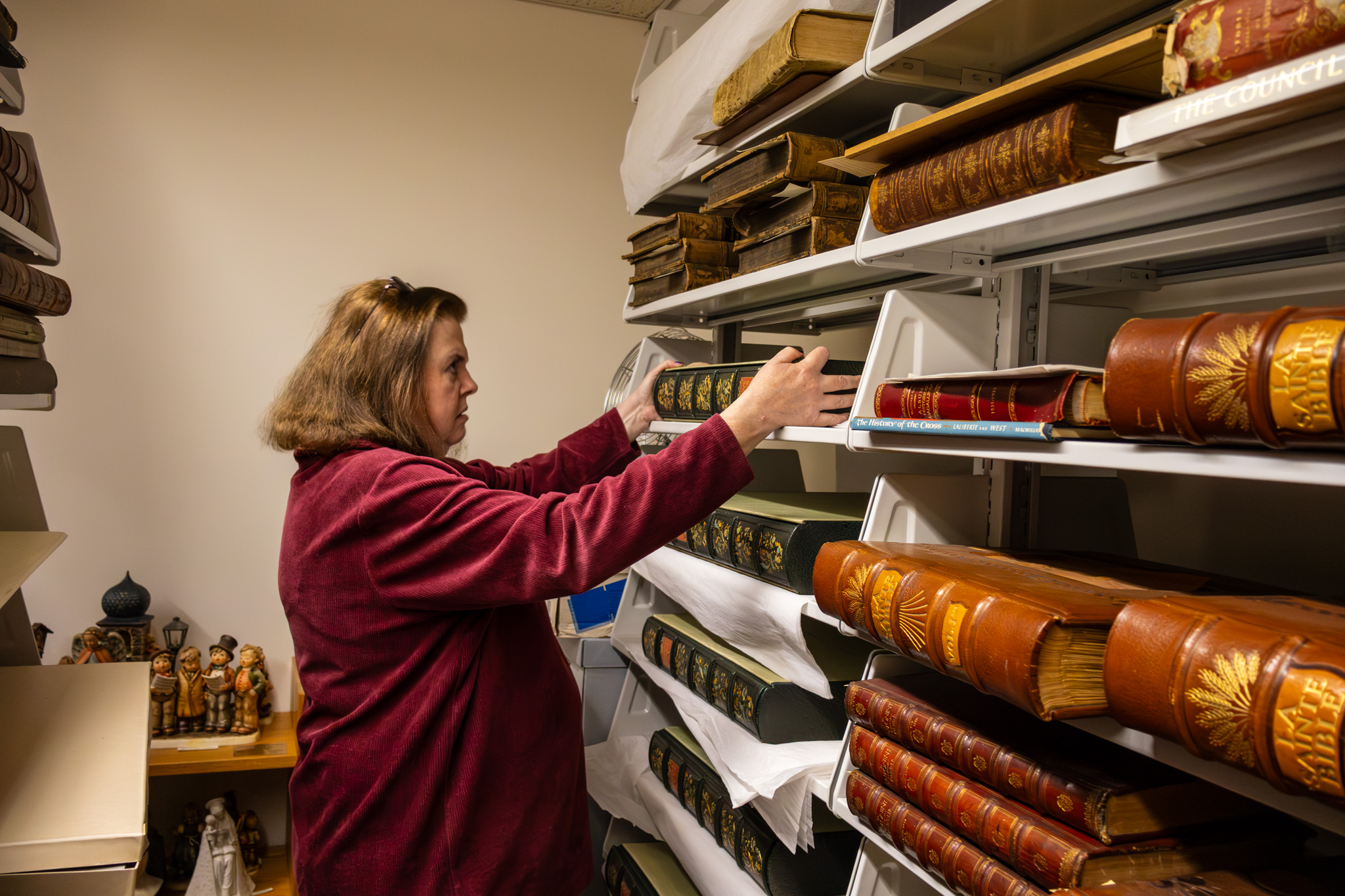
Hidden—but not on purpose—on the lowest level of the Cushwa Leighton Library one can find several medieval manuscript codices (ancient manuscripts in book form), fragments (surviving, but incomplete, handwritten documents from the Middle Ages and Renaissance), and documents, including pieces from the Apostolic Chancery, and incunabula (anything printed before the year 1501).
In fact, one can find well over 4,300 of these items tucked away in a space known as the Rare Book Room.
At the College, students and faculty members have unique opportunities to engage with these rare books and manuscripts. Describing this uniqueness, Associate Professor of English Sarah Noonan, PhD, said: “At most institutions, a rare book room is held at an arm's length, often to preserve books and ensure they are kept in good condition for as long as possible. And while that is a good approach, Saint Mary’s is willing to allow students to walk the aisles and discover where a book sits on a shelf. That is not an experience typical of an undergraduate.” Noonan is the Susan and Joe Pichler Chair in the Humanities.
In addition to these medieval manuscripts are autographed first-editions by Virginia Woolf, five volumes of Rizzoli Bibles illustrated by Spanish surrealist painter Salvador Dalí, works by Sir Isaac Newton, autographed works by Thomas Merton with personalized notes to his friend, Sister M. Madeleva Wolff, CSC, and several art house publications; and in 1941, an anonymous donor gifted the College over 1,000 rare Dante Alighieri publications, including two copies of The Divine Comedy from 1477, as well as an early printed edition of Convivio.
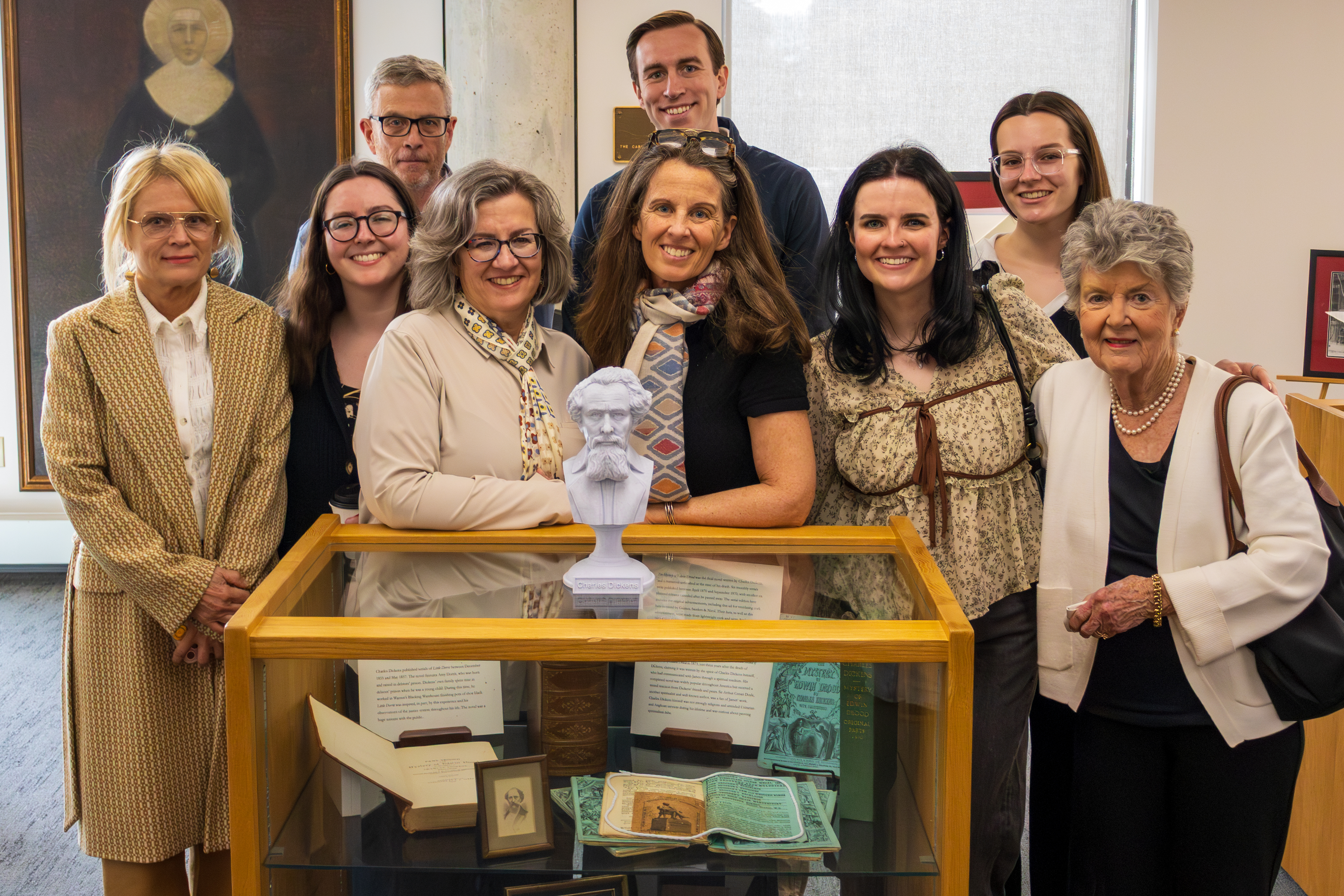
In the fall of 2024, the Cushwa-Leighton Library received a call that excited scholars across the College. The family of late alumna Lenore Hennebry Madden ’61 gifted the College her personal Charles Dickens collection. In March 2026, several of Madden’s family members gathered with students, faculty, and staff to unveil their mother’s collection. Daughter Lenore Madden McCarter ’88 said her family hopes the College will use these books to teach about the Victorian Era, as well as the disparities Dickens depicted in his novels.
The addition of this collection further supports the broader mission of the College’s Rare Book Room. Since graduate school, Noonan has always been fascinated in the history of text transmission, how stories and documents circulate, and medieval manuscripts. “Every book in the medieval period is a unique object with its own unique history,” Noonan said. “I found that I like the complexity of these objects so much, that it has consumed much of my scholarship throughout my career.” So, when she arrived at Saint Mary’s in 2015, she heard whispers of a Rare Book Room containing medieval manuscripts. Thinking, “That’s weird, [the manuscripts] are not in any finding aids,” Noonan familiarized herself with the room, working alongside the outstanding team of librarians.
Deeply valuing the Library’s dedication to ensure the Rare Book collection serves as an accessible resource for the College’s intellectual life, Noonan added that itis because of people like Jill Hobgood ’83, the Marketing and Outreach Librarian, and Joe Thomas, the Library Director, that the students are able to benefit so fully from the Rare Book Room's collection. Hobgood and Thomas are who truly create the numerous, generous, and highly collaborative opportunities for students, faculty, and staff.
Because of the collaborative environment, the same academic year she arrived at Saint Mary’s, Noonan applied for a summer research grant to better understand the objects and books in the Rare Book Room and eventually translate her findings to the classroom, folding them into her curriculum. But it became something much larger: today, Noonan and the Library work with colleagues across 22 institutions across the Midwest, digitizing materials in various rare book rooms. This is called the Peripheral Manuscript Project.
“Collections of books and libraries have always been at the core of what a college or university does,” says Noonan. “Libraries are at the core of all knowledge collected within institutions. They preserve culture, history, and the greatest works of civilization.” Scholarship has become a part of higher education within a college or university context, as well. Rare book rooms have become real resources for institutions and for scholarship in the humanities. Take Noonan’s example: “Anybody could read Dante's Inferno. “Anybody could read Dante's Inferno. But if one enters a rare book room, what they will find is early editions of the book that date back to the fifteenth century and other items connected to that work in a way that goes far beyond what the public can access in a standard paperback edition.”
Noonan's example allows readers and thinkers to view rare book rooms as a sort of "laboratory” for the Humanities. “They are spaces students and scholars can go to test ideas and experiment viewing how literature read today has been read across time. There, it is all laid out, allowing for new and different ways of appreciation and understanding.”
April 30, 2026