

How to Solve a Murder at Saint Mary’s
The Forensic Science Institute, a Popular Summer Program
By BARBARA ALLISON
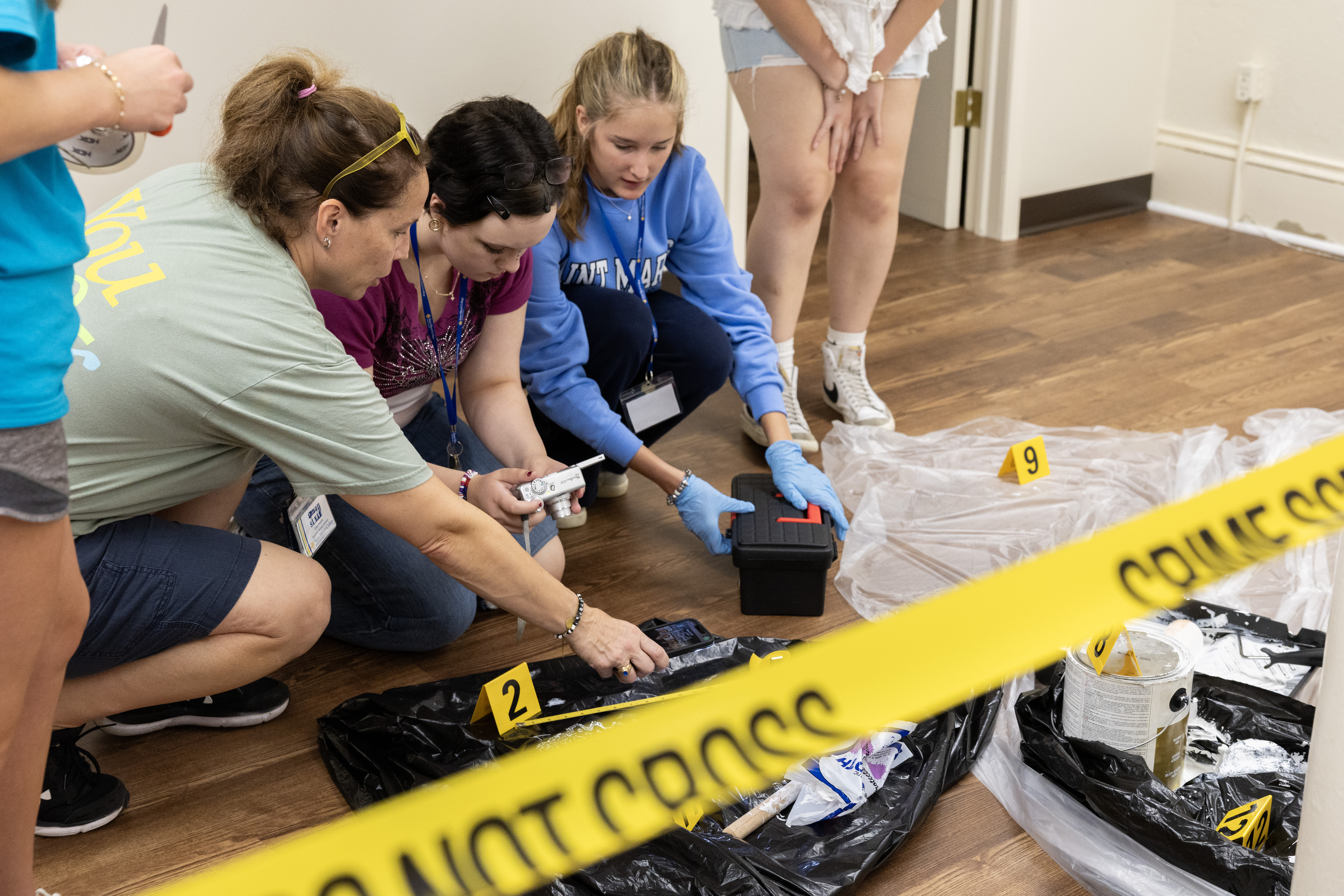
A group of fledgling forensic investigators walked into Bertrand Hall on a recent, sweltering Monday morning. The staged crime scene was chaotic and gruesome. The owner of a local painting company was found murdered, his body stuffed in a closet, wrapped in a plastic tarp with paint and blood on it. There was trauma to the front of his head.
Once the scene was secured, the students, much like real-life homicide investigators, documented and photographed the scene and gathered evidence such as hair, fiber, and fingerprints.
As part of the Forensic Science Institute, one of nine summer programs at Saint Mary’s, the students spent the week mired in details and speculation. Directed by Susan Skube, a professional specialist in the Department of Biology, the Institute teaches students how to use science, technology, and deductive reasoning skills in the areas of forensics and criminology. It’s one of the College’s most popular summer programs: each year, the two one-week sessions are among the first to fill.
“This camp helps participants learn how to use facts and evidence to critically think about the events leading up to a crime. I especially love that these critical thinking skills are applicable in so many aspects of life,” Skube said.
The week before the campers’ arrival, five volunteer faculty and staff who agreed to portray crime suspects filed into a lab in Mathile Science Hall to be fingerprinted, have mug shots taken, and provide hair samples. They learned the crime’s scenario, their relationship to the victim, and their own motives and opportunities for committing the murder.
In this case, the “victim”—Travis Swift, owner of Prestige Painting—was murdered by one of the five suspects, who each had motive to commit the crime.
Students worked together to solve the murder by analyzing evidence left at the crime scene, conducting suspect interviews, and using scientific skills they learned during the week from professors from the College’s Chemistry and Biology departments. They also took a field trip to the South Bend Police Department’s crime lab for added inspiration.
“The number of students who specifically choose our camp because they want to pursue forensic science as a career is on the rise,” said Skube. “The camp serves as a stepping stone from that early high school career interest in crime solving into a path that will set them up for success as they prepare to study science once they get to college.”
It is such a privilege to see the students become invested in solving the crime. It is remarkable how students use the week to blossom into confident young scientists who pick up new skills like blood testing and DNA analysis, especially if they didn’t know they had a passion for scientific study prior to this camp.
- Susan Skube
Samaria Gerbregziabhar, a rising senior at Cardinal Ritter High School in Indianapolis, enjoyed the week-long immersion in science and technology. “The professors were very knowledgeable and kept us engaged,” she said. “They gave us a good idea of what it’s like to work in forensics. It was eye-opening to see what it's actually like.”
Skube and her fellow STEM professors kept students focused on the facts of the case in an effort to follow the evidence where it leads them. “In our excitement to figure out the crime story, it can be really easy to make assumptions and uninformed opinions about the case because campers are fond of the suspects or initially tricked and misled by the suspect or the evidence,” she said.
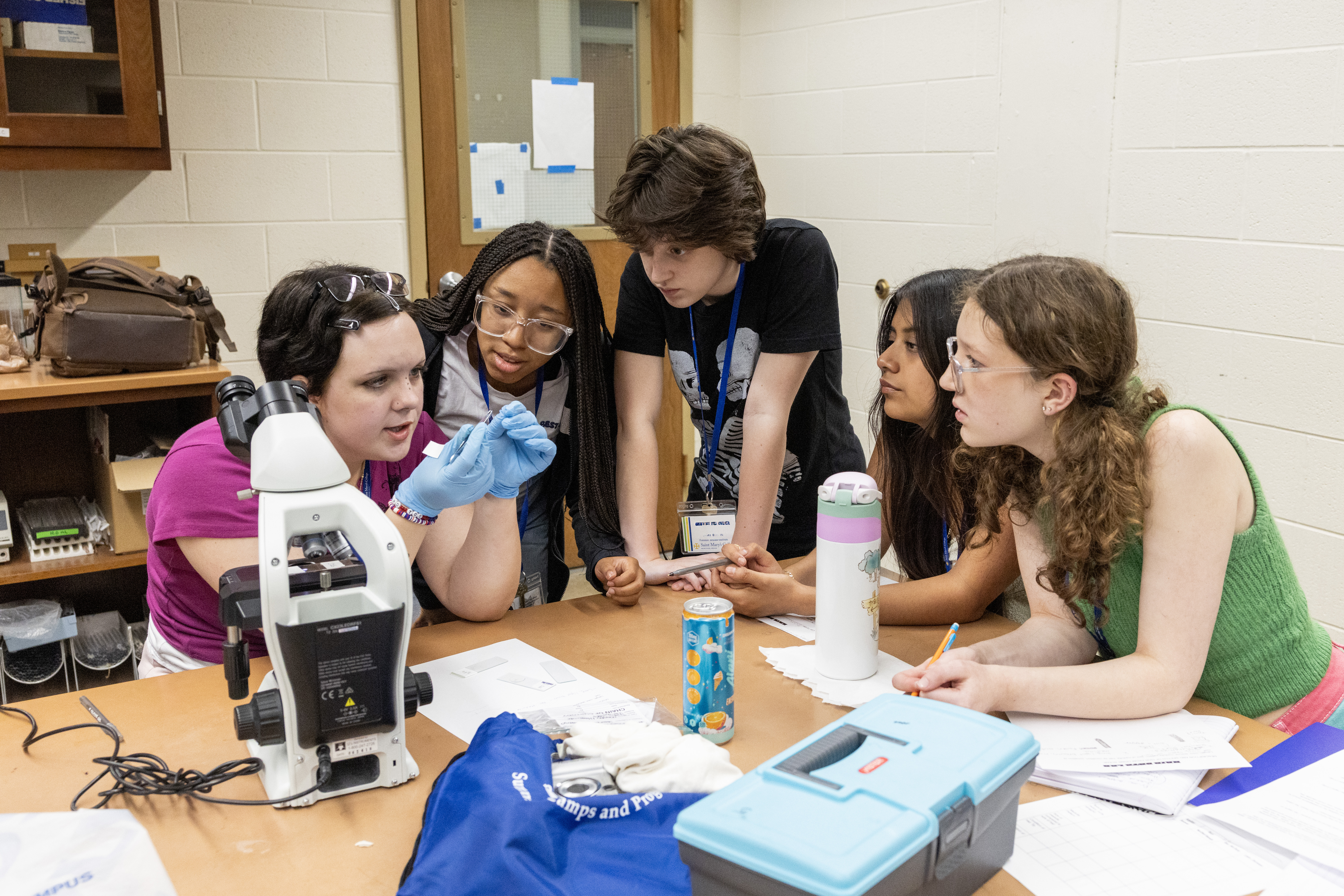
Throughout the week, students spent time extracting evidence from the crime scene, working in the lab to analyze the evidence, and drawing conclusions based on the science. They also had two opportunities to question the five suspects. Gerbregziabhar, who was an interrogator of the suspect pool, relished the opportunity to examine trace evidence to see what the story tells. “Whether it's hair, fibers, or fingerprints, wherever you go, you're going to leave a mark,” she said.
In week one, the victim's killer was volunteer suspect Lara Zarsson, who knowingly added crushed-up peanuts to the burger she brought to Swift, who had a severe peanut allergy. Another suspect, Justine Beaver, happened upon the scene while Swift was in full-blown anaphylactic shock, misread the situation, and hit him twice with a wrench. Her actions were deemed self-defense. The scenario flipped in week two, with suspect Rae McTate brandishing the wrench and both Zarsson and McTate deliberately poisoning Swift by placing crushed peanuts in his burger.
In both weeks, most of the student investigators correctly identified the killer(s). “I like to finish by reading the entire crime story with the details, showing how each piece of evidence the campers interacted with is linked to the suspects and can result in identifying the guilty culprit(s),” Skube said.
“It is such a privilege to see the students become invested in solving the crime,” she added. “It is remarkable how students use the week to blossom into confident young scientists who pick up new skills like blood testing and DNA analysis, especially if they didn’t know they had a passion for scientific study prior to this camp.”
August 10, 2026