


Research Focus: Advocating for Women's Health
By BARBARA ALLISON
When Erica Albertin, assistant professor of Exercise Science and Biology, joined Saint Mary’s Biology Department faculty last year as the director of its newest major, Exercise Science, she was excited about the move from college athletics to academia and the opportunity it afforded her to conduct research with her students.
This summer, she’s working with Ava Hess ’27 on a project titled Female-Centered Autonomic Physiology: Foundations for Exercise. One of their reasons for choosing this project, Albertin noted, is that only 6 percent of the research in exercise science focuses on females. For Hess, her desire to study autonomic nervous system (ANS) dysregulation is personal: she manages the condition on a daily basis.
Their research is supported by the Maryjeanne R. Burke and Daughters Student Independent Study and Research-SISTAR grant.
In this wide-ranging and ambitious project, Hess and Albertin, along with Katie Whitlow, assistant professor of Biology, seek to determine whether symptoms commonly reported by women such as fatigue, stress, anxiety, dizziness, and burnout may be linked to ANS dysregulation. ANS dysregulation occurs when the body struggles to balance its involuntary functions, such as heart rate, blood pressure, digestion, and temperature regulation.
“In advocating for women and women’s health, as a women’s institution, we are also trying to fight the medical machine of research testing that is primarily done on men,” Hess said, adding that 24 women from the campus community volunteered to participate in their study.
The autonomic nervous system regulates so many bodily functions that two patients can exhibit similar symptoms, but the cause for each may be different. ANS dysregulation is also difficult to diagnose, usually about seven years following the onset of symptoms, according to Albertin. While anxiety can be one symptom linked to ANS dysregulation, women often receive it as a blanket diagnosis. “As women we’re often told that we’re being dramatic when in reality, something isn’t working, but because it’s not well-studied, we don’t know that,” Hess said.
Albertin agreed. “Diagnosing ANS dysregulation is difficult because it’s such a wide umbrella of conditions. People think about anxiety and depression as mental health issues, but they could also be related to how the nervous system works,” said Albertin. “That’s why we want to have these groups of participants, to see if we can find any correlations.”
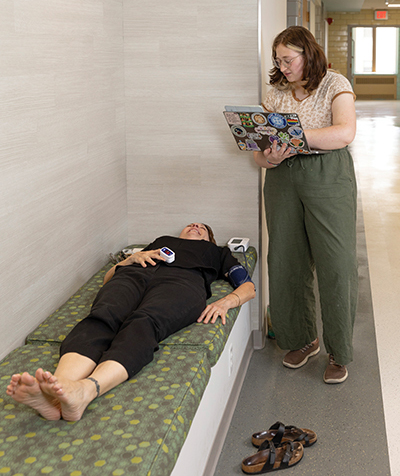
Following a thorough evaluation of the existing literature, Albertin and Hess designed their research protocol to include three different tests and a set of questionnaires. Upon arrival, each volunteer participant was fitted with a heart monitor under the sternum, a blood pressure cuff, and a pulse oximeter, which measures blood oxygen and pulse rate. Next, the participant lay down for five minutes, allowing Hess to obtain resting vitals.
In advocating for women and women’s health, as a women’s institution, we are also trying to fight the medical machine of research testing that is primarily done on men.
- Ava Hess ’27
Next up was the NASA 10-minute lean test, in which participants placed their heels on tape marks on the floor six inches from the wall and leaned back with their shoulders. A blood pressure reading was retaken at one minute intervals. This test helps identify numerous conditions related to ANS dysregulation, including lightheadedness, dizziness, and possible fainting upon standing related to blood pressure regulation. “The 10-minute lean test was designed by NASA to evaluate their astronauts for orthostatic intolerances,” Hess said. “Essentially, it assesses how well they tolerate changes in body position.”
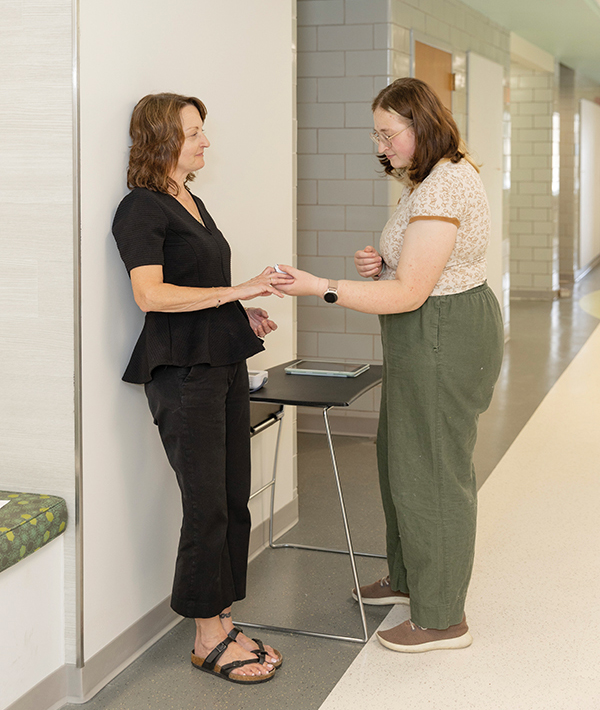
The questionnaires asked participants about sleep, menstruation, and caffeine consumption, which can all affect ANS dysregulation.
Following the questionnaires, participants wore a pedometer with the heart monitor and walked for six minutes, reporting their perceived levels of exertion at regular intervals. About 10 days later, participants returned to repeat all the tests except the NASA 10-minute lean test.
“One of our primary objectives is to see if exercise helps,” said Albertin. “There’s a lot of conversation in the field about ‘exercise snacks,’” she explained. “Instead of doing a whole workout, could we just do 10 squats, maybe after lunch, that help our automatic nervous system reset and help us be more regulated?” The concept of “exercise snacks” is gaining momentum in the research community to ascertain if small amounts of exercise throughout the day can help with ANS dysregulation, rather than an hour-long workout at the gym, showering, and returning to work, which can feel like a lot for busy women.
“When we ask people about how active they are, we’re trying to see if there is a correlation between activity levels and their level of autonomic nervous system dysfunction. We can’t necessarily say that something like that is causative, because it’s a chicken and an egg situation,” Hess explained. “In my case, did I develop autonomic dysregulation because I stopped exercising, or did I stop exercising because I feel terrible all the time?”
Continued research into ANS dysregulation is vital because of the dearth of data on female subjects and a lack of answers into this often-debilitating condition. “Our goal is to expand research because ANS dysregulation is so under-researched. Getting more information, even if it’s correlations, is going to be helpful because it’s practically nonexistent right now,” said Hess.
“Establishing those correlations can help future researchers look at actual causative agents to see where we can grow our knowledge both in autonomic nervous systems and then as a foundation for exercise,” Hess said.
“I’m thankful that Dr. Albertin and Dr. Whitlow continue to help me with this project. I couldn’t do it without their support. This is a big undertaking,” said Hess. Hess’s post-graduation plans include a gap year and application to medical school to earn her doctorate of osteopathic medicine. ‖
Grants Expand access to student-faculty summer research
In the strategic plan Revere and Revise 2030, the College committed to develop new student research opportunities. This summer, 41 student-faculty research projects were conducted on campus and in the community—a 78 percent increase from 23 projects last summer.
The elevation of such mentored research is due in part to the increase in funding secured specifically for this purpose. In addition to a record number of summer research projects, over 100 grants to support travel, conference fees, and supplies were awarded to students during the past academic year. And, for the first time ever at Saint Mary’s, grant funding provided on-campus housing and meals for student researchers, according to Bettina Spencer, Director of the Office of Academic Research, Grants, and Sponsored Programs.
“The research office has worked hard to make summer research more accessible to every student,” Spencer said. Typically an upper-level experience, “this year, I asked faculty to identify first and second-year students who they think might be good prospects for research opportunities to get them in the pathway earlier.” To that end, 14 first and second-year students are working with faculty in collaborative research this summer.
The expansion of student-faculty projects and funds also reflects a collaborative effort between the Office of Academic Research, Grants, and Sponsored Programs and the Saint Mary’s Advancement team. “Advancement does a great job working with donors, and that’s increased the number of students participating in research this summer,” said Spencer. Last September, Saint Mary’s received a $100,000 planning grant from the National Science Foundation (NSF) to streamline current research processes, including grants infrastructure, needs assessments, and finding impactful ways to collaborate with similar institutions.
While data from the studies conducted with the NSF planning grant is still being collected, Spencer is confident it will undoubtedly lead to increased access, earlier student involvement in research, further experiential learning opportunities, and year-round research opportunities that allow students to ladder-up their research throughout their college careers.