

Saint Mary’s Language and Literacy Lab Hosts Read-In with ECDC Students
By BARBARA ALLISON
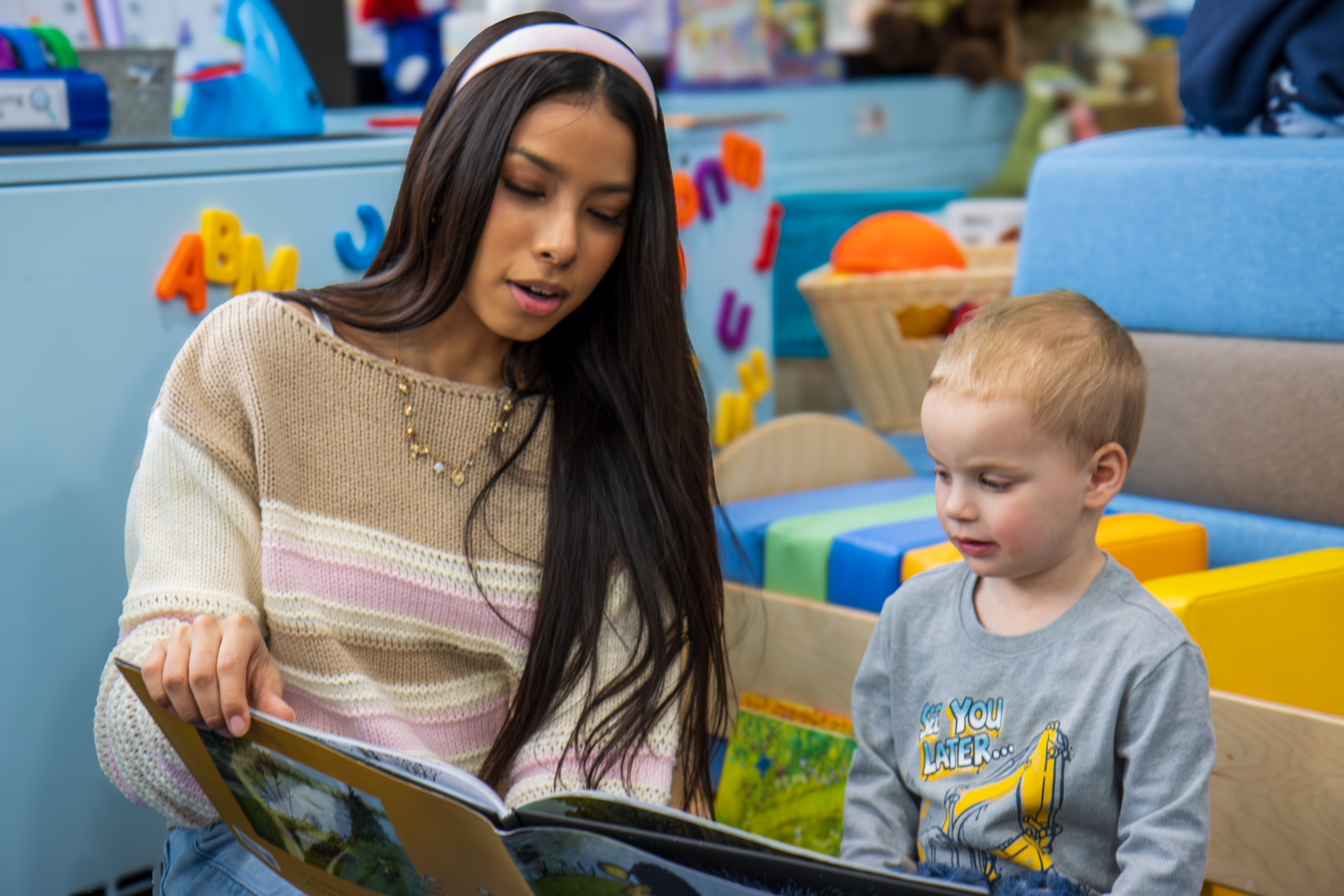
On March 18, about 100 children from the Early Childhood Development Center (ECDC) at Saint Mary’s descended upon the recently opened Language and Literacy Lab in Havican Hall for a Read-In. As they entered the room, the children carried a favorite book they had selected from the shelves outside the room. Many also carried the stuffed animal—or “lovie”—that corresponded to their chosen book.
March is National Reading Month, and the goal of the Read-In was to foster a love for reading and learning while simultaneously supporting the child’s cognitive, social-emotional, and language development, according to Susan Olney Latham ’91, professor of Speech-Language Pathology and director of the Language and Literacy Lab at Saint Mary’s College.
About 20 Saint Mary’s students volunteered to read to the students. “I want children to fall in love with books. Reading to children is one of the first ways a love of reading is fostered,” said Latham. “We read to children to build community, to demonstrate expressive reading, to make connections between words read aloud and the words written on the page, and to share different perspectives.”
Volunteer Fernanda Lopez ’29, an elementary education major from Marengo, Illinois, fondly recalled her parents reading to her as a child. “When I was younger, my parents would bring me to the library, and we would sit down and read together. Those are some of my favorite memories,” Lopez said. “That interaction is something that resonates with me. I enjoyed reading and I want to be a part of making reading enjoyable for these children as well.”
Currently in its inaugural year, the Language and Literacy Lab provides direct language and reading intervention to children and parent education. The lab is also used to train undergraduate and graduate students as well as school-based professionals. It was made possible through a grant from the Gladys Brooks Foundation and a generous donation from alumna Susan Scherer Calandra ’72. The Gladys Brooks Foundation's mission is to provide for the intellectual, moral, and physical welfare of society by establishing and supporting non-profit libraries, educational institutions, hospitals and clinics.
Fostering a love of reading is critical for children’s academic success. “In St. Joseph County, between 30 and 40 percent of third graders can't read,” Latham said. “We need to make sure that kids are prepared when they're going to kindergarten.” She said reading helps in building vocabulary and writing skills in students. “The words students read are words that they seldom encounter in their speaking vocabulary. That's really important when children learn to write, not the mechanics of writing, but in generating a story. Those words come from their reading vocabulary.”
In 1995, researchers Betty Hart and Todd Risley discovered a 30-million word gap between 3-year-olds raised in households of professionally employed parents versus 3-year-olds raised in households of parents receiving public assistance. They published their work in the book Meaningful Differences in the Everyday Experiences of Young American Children. “Talking to children is not enough. We must read. It is only in print that children will encounter rich vocabulary words not spoken in our small speaking vocabularies,” Latham said.
I want children to fall in love with books. Reading to children is one of the first ways a love of reading is fostered. We read to children to build community, to demonstrate expressive reading, to make connections between words read aloud and the words written on the page, and to share different perspectives.
- Susan Olney Latham ’91
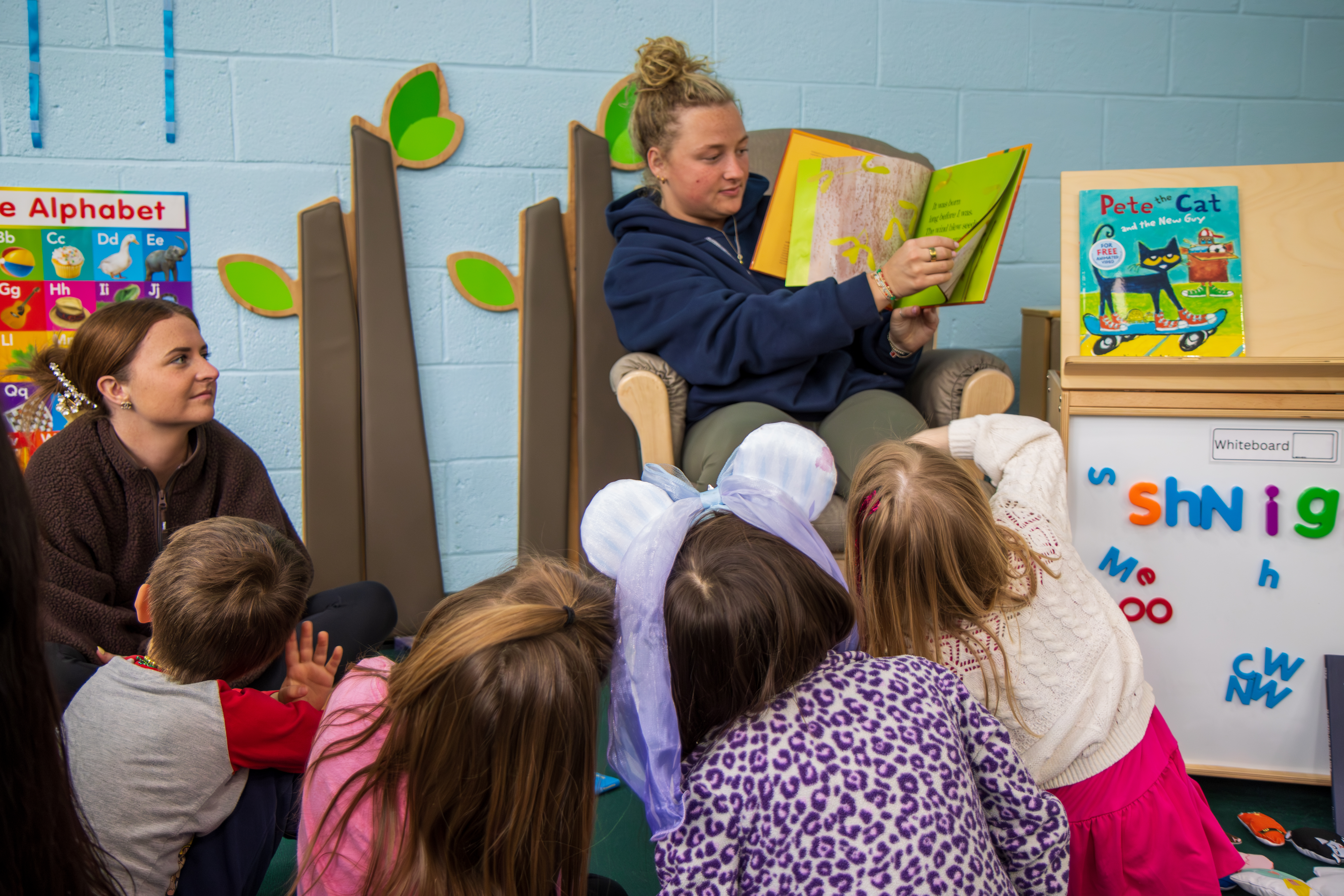
Children grow their listening vocabulary through the words they hear, Latham added. “It all begins with the listening vocabulary. Children need to hear words. The only way vocabulary can enter the human brain is through seeing or hearing and for a young child, this demonstrates the importance of hearing words being read aloud.”
Speech-Language Pathology (SLP) student clinician Hailey Harness ’26 sees children making these important connections between hearing, seeing, and reading words in her work in the Language and Learning Lab. “It’s putting the words we speak into our reading sessions,” she said. “It's such a confidence boost for the students as they grow their skills. I recently said to one child, ‘Oh my gosh, you just read that!’” Studies show that reading with children also promotes overall well-being, strengthens family bonds, increases the child’s attention span and cognition, and is downright fun.
That fun and energy was evident as children selected books and settled into the laps of the volunteers. An ebullient Cameron, age 3, delighted in his ability to predict what would happen next in the story by putting together the words he heard with the visual cues in the illustrations of his selected book, Maurice Sendak’s Where the Wild Things Are. Usha, also age 3, loved counting the cupcakes and naming their colors as they disappeared from the windowsills and shelves in her chosen book, Pete the Cat and the Missing Cupcakes by Kimberly and James Dean. Both Cameron and Usha cuddled the corresponding “lovie” for their book while listening to the stories.
“It's such an intimate bond to have someone read to you,’ said SLP student clinician Montserrat Vazquez Diaz ’26. “When I was reading with two little kids, one of them kept wanting to flip the page, and the other one said, ‘Wait! We have to slow down and read all the words on the page, just like my mom reads all the words on the page.’” Diaz noted that reading aloud to children builds their understanding of words and expands their spoken and written vocabularies.
Latham agrees: “By reading aloud to children, I am telling them that this book is important and worth reading.” According to the Commission on Reading’s 1985 report, Becoming a Nation of Readers, the single most important activity for building the knowledge required for eventual success in reading is reading aloud to children. “All academic success is based on a child's ability to read,” Latham added.
March 27, 2026