


In the Spotlight: Frances Bernard Kominkiewicz
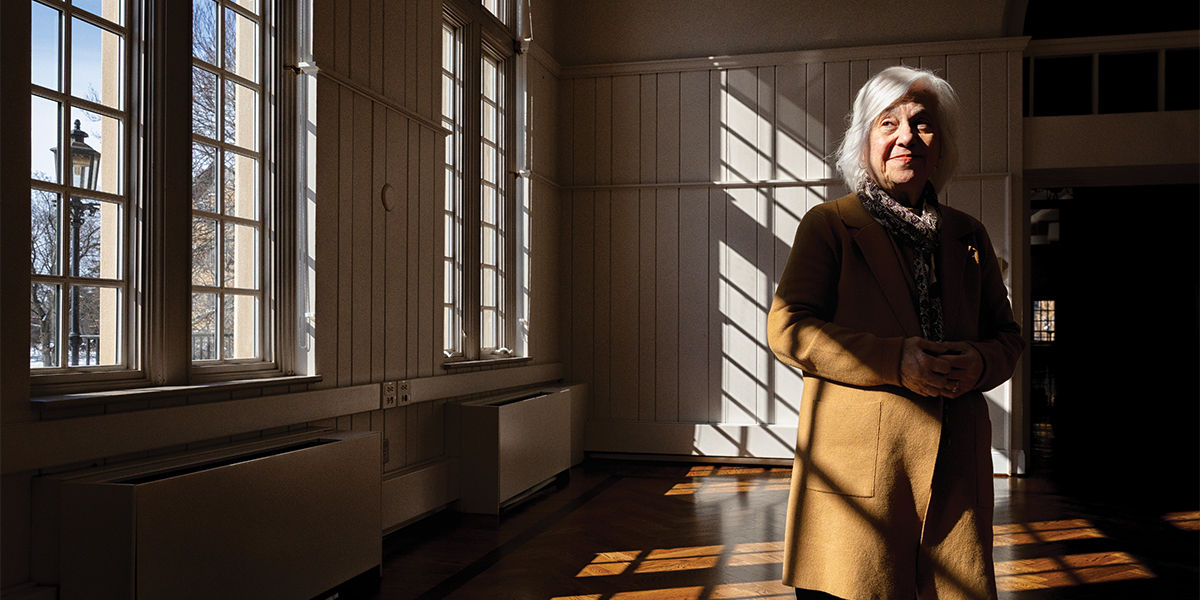
By LISA KNOX
You are a fierce advocate for our students, on campus and off. What makes the Social Work program special?
Students who come to Saint Mary’s are so strong; they’re so smart. We have designed the bachelor’s and master’s program so when they graduate, our students meet or exceed expectations. At the bachelor’s level, the BSW, they study for and take their licensing exam. The MSW program provides our students with a strong background in clinical social work with a focus on mental health. I have worked here since 1997, and I feel strongly that my legacy has been in making sure our students are ready.
Why is this important?
Our colleagues in the field know they can expect Saint Mary’s graduates to have the skills that are industry gold standard. With their licensure, our BSW graduates can supervise others and do more with clients. With their master’s, they understand social work programming and systems. Then they have this wonderful background in the liberal arts that gives them knowledge, confidence, and abilities. On top of all that, we provide them with boots-on-the-ground experience. When you put all of this together, they are just unbeatable. It’s evident that each student receives such great care under your guidance. It’s not just my guidance, it’s the program, and the College. Like our career office which offers lifetime resume building, the social work team stays available to all social work alumnae if they need anything for future licensing or finding a position. It’s not a responsibility, per se, but we like to see our students and alumnae flourish.
What sparked your interest in social work?
I grew up in a family in which you were taught to give back to others. I began my journey in deciding how to help others through nursing, education, and psychology, all of which call for a very particular set of skills and emphasis on specific ways of helping others. I was very fortunate to have caring people in those professions who helped lead me to social work.
Did that start at home?
My dad would say ‘you’ve just got to learn to talk your way out of things because you’re five foot two.’ It was interesting, because when I look back at how I was raised, there was never any differentiation between whether boys could do this or girls could do that. My dad just taught me how to do it differently. ‘You’re still going to do this, but you have to do it a different way.’ We understood resourcefulness. And caring.
Does family continue to influence you?
My route here is reflective of having many mentors and so many others who also cared about me, especially my children and friends. My two children have been a great influence on me in many ways. My daughter, a Saint Mary’s alumna, is a lawyer and a clinical social worker, and my son is a documentary filmmaker, editor, and a post-production pipeline specialist. They both care deeply about the world and others, and always remind me of our responsibility to help others.
How has your teaching changed over the years?
National accreditation used to mean that we always focused on specific areas in the curriculum, such as research, social policy, and an understanding of diversity. Over the years, that focus shifted to competency-based as in other professions, such as law and medicine. This means we are focused on learning as truly life-long.
Our colleagues in the field know they can expect Saint Mary’s graduates to have the skills that are industry gold standard.
- Frances Bernard Kominkiewicz
What about today?
The MSW program is tech-forward and relationship-focused. Not only are we strong in technology but we’re equally strong in caring for every aspect of our students’ learning. We have a teaching specialization in clinical social work and mental health so that students will be very well-prepared to be clinical social workers, but also will be able to supervise other social workers, serve as CEOs, run organizations, and attain their goals.
What do you hope students take away from a course with you?
I hope that my students gain knowledge in how to work with others, especially how to be accepting and collaborative in making changes, as that is the foundation of social work. I hope that students not only gain the knowledge and skills to help make changes in this world, but also understand that everything they do can have an affect on others.
What does today’s social worker look like?
Social workers are able to work in three types of settings, sometimes simultaneously: micro, mezzo, macro. They are able to provide or find resources to help individuals. They work with institutions like schools or companies, and they are able to advocate for policy change. They have perseverance and compassion—and a lot of skills in negotiation. They also care.
What does the future hold for social work?
Social work is the kind of profession where you can go into a lot of different industries. The Bureau of Labor Statistics projects the overall employment of social workers to grow 6 percent from 2024 to 2034 which is faster than the average for all occupations. Social workers provide the majority of mental health services in the United States.
I understand you used to have a nickname that some might call foreshadowing?
I attended Marian High School, and my nickname was “mom”—in a good way. My friends would ask me for advice all the time. From age 16 to 19, I worked as a nursing assistant and was seen as someone who could manage people in a way that helped people feel comfortable. I would supervise those who were in their 20s and 30s. I have always been good at being able to prepare people for almost anything, but I didn’t know how to be any different.
May 11, 2026