

Challenges Accepted: Chinaza Ezechikamnayo, Class of 2026
By BARBARA ALLISON
For senior Chinaza Ezechikamnayo ’26, Saint Mary’s will always be a place of becoming. “I wanted a place that had community and guidance. Saint Mary's gave me the space to try so many different things—philosophy, ballet, painting, literature, biology—so I could find what was really important to me. I think that's the value of a liberal arts education,” she said in a recent interview.
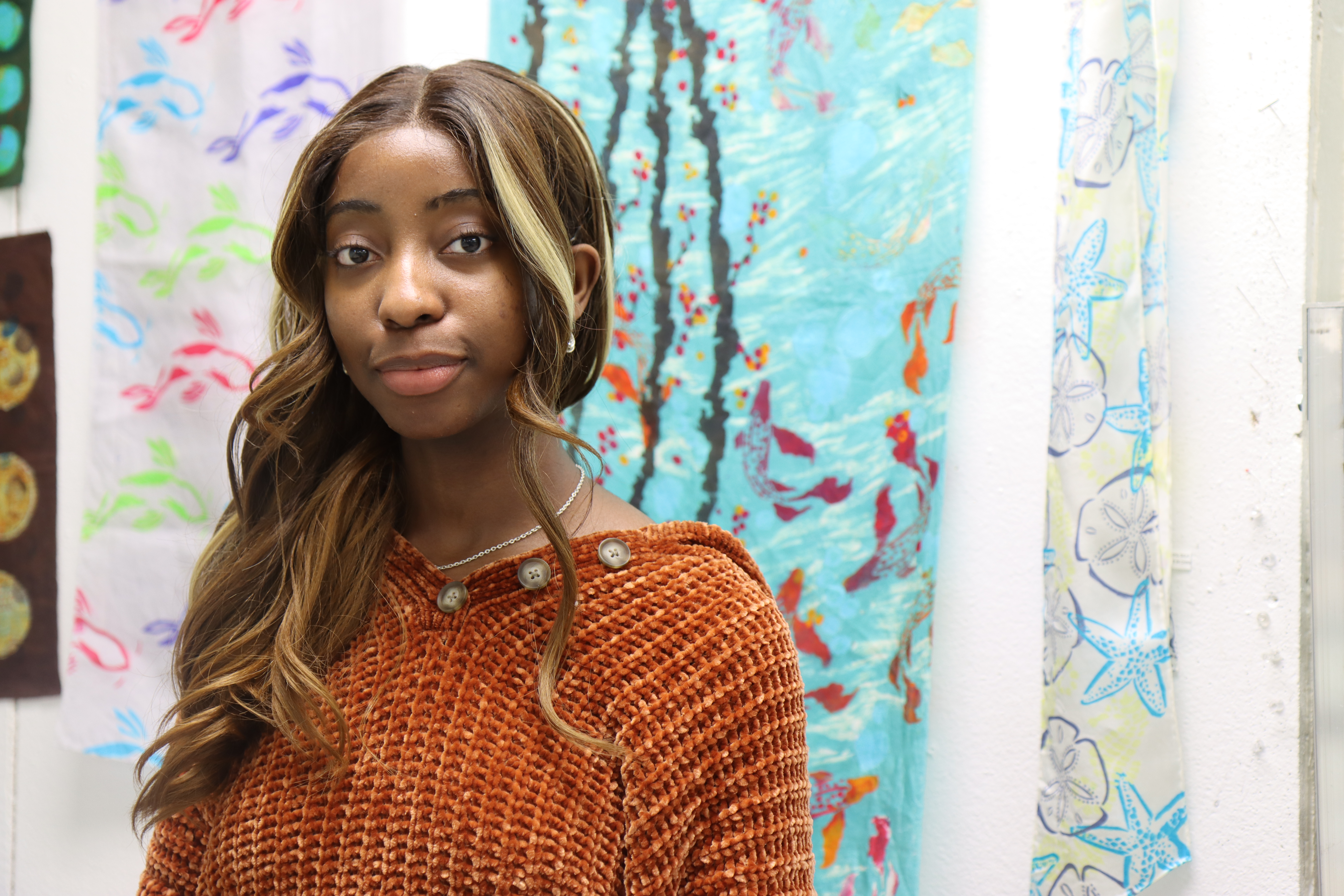
On May 16, Chinaza will graduate with her Bachelor of Arts degree in Philosophy and Studio Art. Saint Mary’s came onto her radar at the African Leadership Academy (ALA) in Johannesburg, South Africa, where she completed her secondary school education in the company of students from across the African continent.
In the ALA scholars program—which identifies and educates Africa’s next generation of leaders and entrepreneurs—students complete requirements that prepare them for university in the US and in other places around the globe. The University of Notre Dame sponsors many ALA scholars. When Dean of Enrollment Management and Marketing Sarah Gallagher Dvorak ’99 connected with the academy, she began discussing ways to recruit students to Saint Mary’s, knowing that there would be a supportive environment in the tri-campus community.
Chinaza emerged as a young woman of potential and promise for enrollment at Saint Mary’s. When she was accepted to the College, she was awarded the merit-based Ralph H. and Mary McGahey Dwan '58 Endowed Scholarship. “This scholarship was one of the most important factors in making the decision of what college I wanted to go to,” Chinaza said. “I wanted to have the space to focus on my academics and not have to worry about where the next payment for my tuition would come from.”
As a teenager growing up in Abia State, Nigeria, Chinaza dreamed big and worked hard to achieve her dreams. At age 14, she was president of her secondary school in Nigeria when she won an essay contest with over 500 contestants. This afforded her the opportunity to become governor-for-a-day of Abia State. “Suddenly, I had all this power, as a teenager, to make change in my community,” she reflected. “It gave me the passion to understand how to connect policy and the lived experiences of everyday people.”
As governor-for-a-day, she channeled her passion into creating educational inclusivity for students with disabilities, and in collecting and distributing period products to women and girls in her community. She knew that school-age girls' educational aspirations are often derailed when they lack these essential personal care items.
That passion flourished at Saint Mary’s, where Chinaza was a Belles Connect student leader, president of the Student Diversity Board, and an intern at the Study of US Institutes in Washington DC, an academic program for undergraduate leaders, educators, and scholars from around the world. “I'm a very curious person,” she said. “I wanted to see what people were doing in other parts of the world.” And indeed, her travels included study abroad trips to Rome, to the Global Leadership Program in Tokyo, and across the US to research policy and its effect on communities.
In summer 2025, Chinaza worked on a student-faculty collaborative research project titled Africana Philosophy as a Model for Public Philosophy with Andrew Pierce, associate professor of Philosophy and Director of Justice Studies at the College. Through this project, she gave a presentation on her research at Penn State University, and engaged in collaborative learning programs with philosophy students from around the world at Penn State, Rutgers University, and Hamilton College. “Public philosophy is philosophy that is done with the community,” she explained. “It's all of the thinking and intellectualizing and philosophizing that you do—not because you've identified a problem and theorized about it. It is taking that theory and putting it into practice within the community.”
Saint Mary's gave me the space to try so many different things—philosophy, ballet, painting, literature, biology—so I could find what was really important to me. I think that's the value of a liberal arts education.
- Chinaza Ezechikamnayo ’26
Pierce noted that Africana philosophy defies rigid, Eurocentric models because it has resisted narrow professionalization and uses philosophical reflection in ways that more directly connect to political realities. “Africana public philosophy is grounded in what I call black humanist practice,” Piece said. “It works collaboratively with outside communities and decision makers about issues that they would like to bring to the table.”
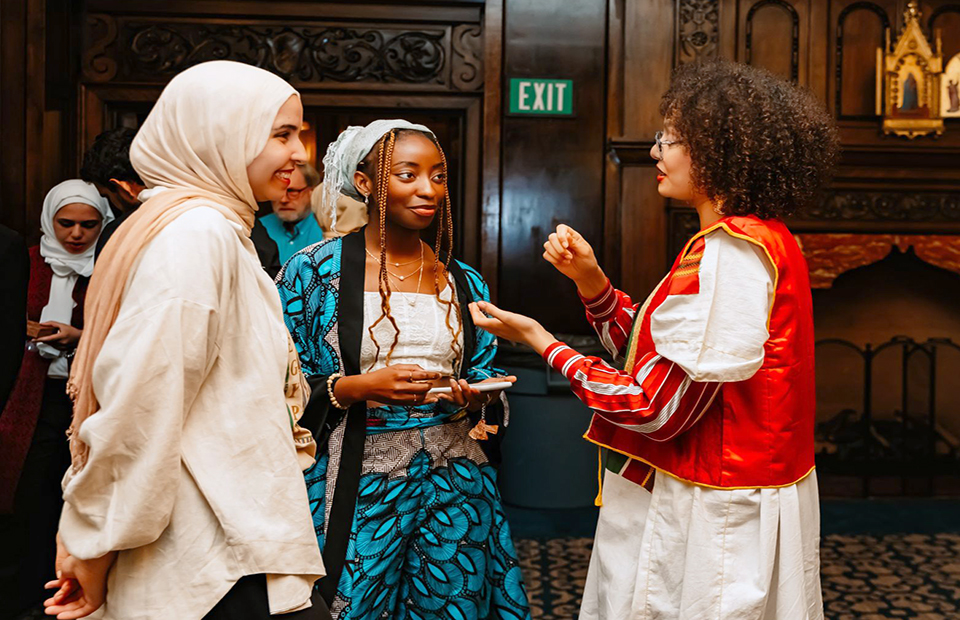
In her project, Chinaza researched notable African leaders and their impacts on the constituencies they served. One was Kwame Nkrumah, a political leader, intellectual, advocate for the Pan-African movement, and the first president of Ghana following its independence from British colonialism in 1957. Nkrumah was also a founding member of the Organization of African Unity, whose administration reformed education from colonialist models and built infrastructure throughout Ghana. Chinaza also studied Julius Nyerere, a politician, anti-colonial activist, political theorist, and the first president of Tanzania, whose model of self-reliant education became the basis for the life’s work of another notable Saint Mary’s alumna, Maria Josephine Kasindi Kamm ’63, who educated thousands of accomplished women in Tanzania.
For this research, which she presented in April at the College’s Research Symposium, Chinaza won the inaugural Williamson Award for Research Excellence. “Saint Mary’s has been a great experience for her, and she has obviously availed herself of every opportunity,” said President Katie Conboy.
Last week, Chinaza presented her senior comprehensive project, Cognitive Colonialism in the Digital World, to a diverse college audience. After her internal presentation to the Department of Philosophy, professor Michael Waddell said, "this might be the best piece of original philosophy I've seen in a senior comp project in my 16 years at the College. It presents a really interesting analysis of a problem that hasn't received much philosophical attention but is profoundly impacting the world today.”
“We have this tool, social media, and it's changing us as a human race,” Chinaza said. “We don’t understand the philosophical implications of the self and the presentation of the self through social media. It’s a hyper surveillance of the self. The way I explain in my comp is how social media transcends individuals with what it does to communities in the world.” She cited as an example young women in western Africa who cut off their hair and wear wigs to match the smooth hair that corresponds to western algorithms of white, normative cultures like Silicon Valley. It’s a form of cultural erasure that’s happening globally.
“Everywhere I go, I see how social media has changed people, how we think of ourselves and how we perceive ourselves and our interactions with each other,” she said. “I grieve what we once were, and I’m imagining a world where we curtail the fracturing effects that social media has on the mind while retaining the benefits of emerging technologies like social media.”
This fall, Chinaza plans to pursue her Master of Arts in International Relations at Johns Hopkins University School of Advanced International Studies in Washington DC. “I’m going to be in a program where I can take all these ideas I have about global risk and global resilience and get the qualifications to make change in the world,” she said. “The world is a stage, and I will go wherever my skills are needed. Saint Mary's is the confidence behind all of the dreams that I have.”
May 13, 2026