

Preparing Nurse Leaders: Inside Saint Mary’s DNP with Dr. Scarlet Spain
By Jennifer Hengehold
Professor. Clinician. Academic director. Researcher. Healthcare consultant.
Dr. Scarlet Spain, who directs the Doctor of Nursing Practice (DNP) program at Saint Mary’s College, is a testament to the expansive possibilities that await graduates of the program.
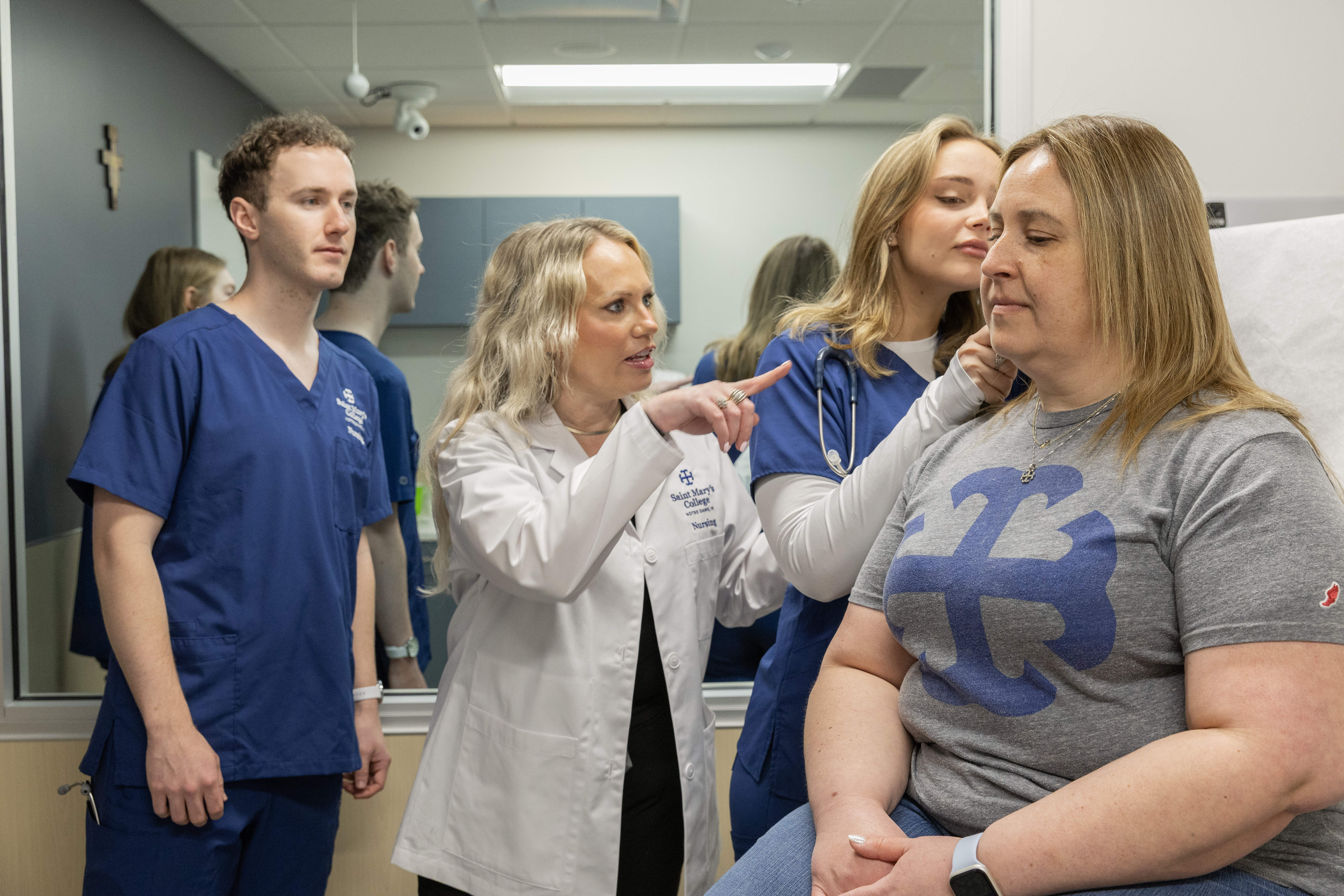
“I do wear a lot of hats—just not all at the same time!” Spain says with a laugh. “I tell our students that there are so many paths you can take with a DNP.”
As the terminal, or highest, degree in the field of nursing practice, the DNP prepares students to hold executive leadership roles in healthcare settings, develop policy, teach at the post-secondary level, and engage in clinical scholarship, translating scientific research into healthcare practices that save and improve lives. Many of these are roles that Spain knows firsthand.
A board-certified family nurse practitioner with specialized expertise in occupational and environmental medicine, Spain came to academia from a distinguished clinical career, including a years-long stint at a global steel company that culminated in her role as senior nurse practitioner and wellness coordinator.
Today, in addition to directing the DNP and Family Nurse Practitioner (FNP) programs, and serving as assistant professor in the College, Spain administers its Certificate in Geriatric Neuropsychiatry. Saint Mary’s is the first in the nation to offer this year-long certificate program for nurse practitioners and physician’s assistants, which prepares them to more effectively care for patients with dementia-related diagnoses.
Spain also maintains an active clinical practice in occupational medicine with a local community-based hospital system; writes peer-reviewed articles and textbook chapters; and regularly speaks and consults in the areas of building healthy and safe workplaces for corporations both stateside and abroad, as well as defining the scope of practice for advanced practice providers.
A Top-Tier Program with a Focus on People
Spain’s CV, while impressive, is also emblematic of the way Saint Mary’s approaches its DNP program. “We work hard to make sure our faculty are true experts in their fields,” she says. Though the DNP is mostly online—typical for graduate degrees geared toward working professionals—the college prioritizes building relationships between students and professors.
“The students get to know us through our video lectures and our open-door office policy,” says Spain, noting that faculty are always available to meet with students in person or virtually in the case of long-distance learners. “We want them to hear directly from experts, to learn from our stories and our experiences in the field. Those connections are what seem to resonate most deeply with students.”
“Another thing Saint Mary’s does really well is the on-campus experience,” says Spain. All DNP students are required to spend time on campus each semester of the three-year program. During these campus immersions, students engage in competency-based education—how to suture, interpret labs, read x-rays, conduct common office procedures, and other hands-on skills—that is difficult to duplicate in a strictly online setting.
The combination of personalized faculty lectures, campus learning, and hundreds of clinical hours in carefully vetted sites around the country are just some of the reasons Saint Mary’s DNP is consistently rated a top-tier program.
Seeds for Back Pain Project Planted Early
For Spain, the expertise she brings to the classroom and beyond has its roots along the shores of Lake Michigan, where she grew up in a steel town that shaped her interest in occupational medicine and workplace safety. “My dad worked in the mills, and so did a lot of my family and friends’ parents,” she recalls.
Spain worked as a nurse practitioner in the mills for nearly a decade, energized by the notion of sending employees home in the same, or perhaps even better, condition than they arrived in. Her job in the mill is a lesson in what nurse practitioners can accomplish. “I worked with hundreds of employees over those years. I knew many of them well and walked some through really hard things, like cancer and other injuries and illnesses.”
She points to successful wellness initiatives like smoking cessation programs and prevention-focused health fairs—not to mention referring employees to specialists when her annual workplace physicals turned up troubling symptoms—as evidence of the impact an NP can have.
These are the sorts of experiences that illuminate Spain’s teaching. They also form the foundation of her ongoing research and quality improvement efforts in occupational medicine—specifically, back pain prevention. Spain has developed an online education module targeting heavy industrial workers like those she continues to care for as an occupational medicine nurse practitioner.
The program aims to raise awareness among at-risk workers about how they can protect their health and prevent potentially devastating workplace injuries, the effects of which could linger for years.
Scholarship with an Impact
Saint Mary’s has placed a premium on recruiting faculty who, like Spain, remain active in their fields, conducting research and scholarship that not only advance knowledge within their disciplines but often provide solutions to real-world problems. As a result, Saint Mary’s students enjoy access to and instruction by highly dynamic and knowledgeable professors—ultimately gaining skills and understanding that make them standouts in the workforce.

Two years ago, Spain’s scholarship attracted the attention of researchers at the Rutgers University School of Public Health, who approached her after seeing her present at an academic conference. A partnership blossomed, and Rutgers now hosts her occupational safety program, which is utilized by several manufacturers in northern Indiana.
One of those manufacturers is ArcelorMittal USA. Robert Joseph, operations manager for their research and development arm, has invited Spain to present her back pain project to around 120 of his employees. He is particularly enthusiastic about the project’s preventative, rather than reactive, focus.
“The awareness she brings to the issue is the most important thing,” says Joseph. “She gives a presentation on back injuries and prevention, and suddenly everyone is talking about it. I look around the workplace, and I see people bending at the knees to lift. I see them thinking things through as they go about their work. And that really has had an impact.”
Spain, he says, is “a celebrity around here. People really listen to her.”
May 4, 2026