

Sparking Imagination in the Spark Lab
By KATHE BRUNTON
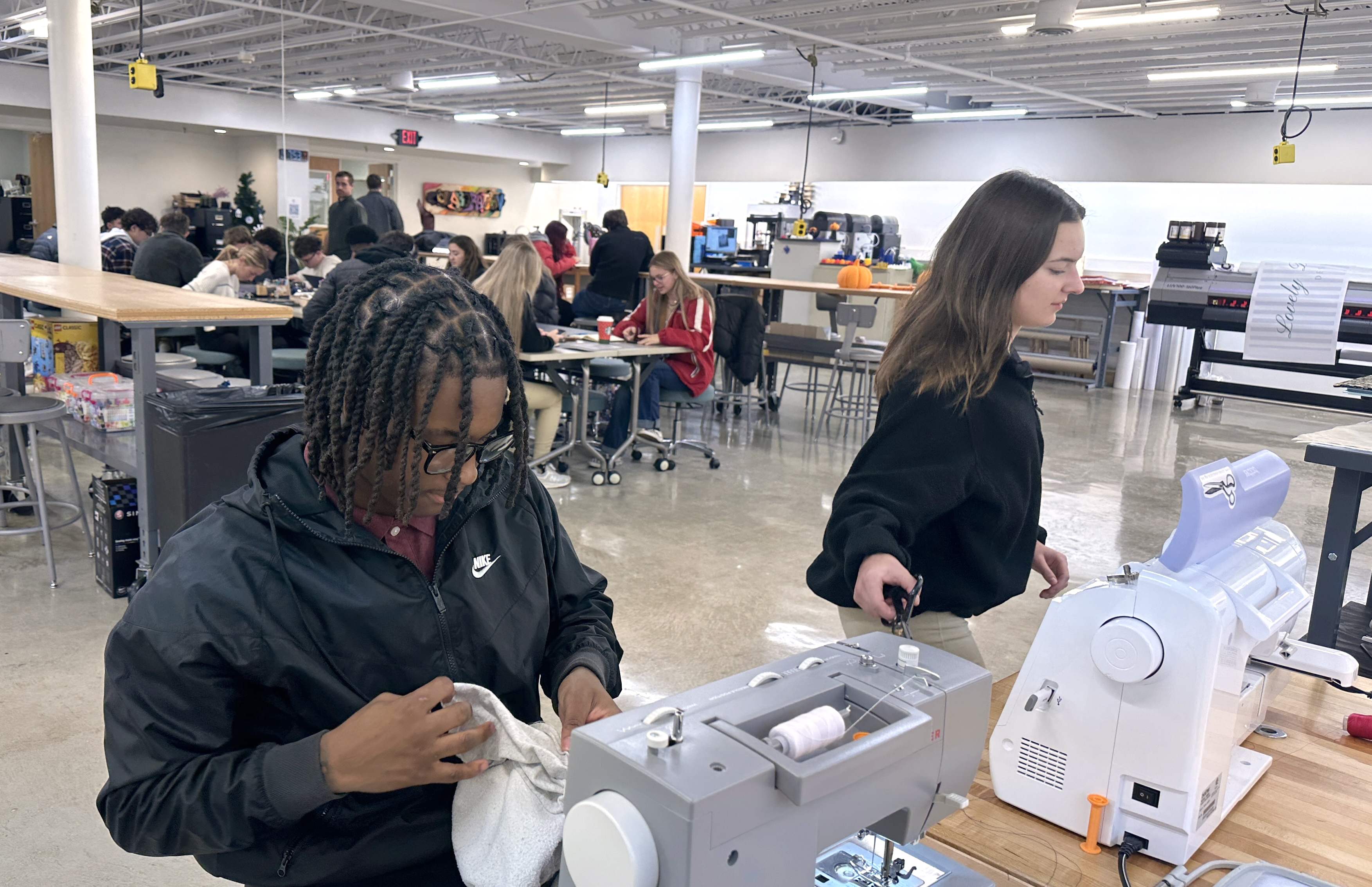
For the past three years, Shreejan Shrestha, Digital Fabrication Instructor in the Department of Art, has directed the Spark Lab, a makerspace that encourages hands-on learning, creativity, and collaboration at Saint Mary’s College. In this open and bright space in Haggar College Center, anyone—students, faculty, staff, and the broader community—can bring an idea for a physical product or craft and walk out holding something tangible.
What began as a creative innovation hub where users could create buttons, stickers, and totes has expanded to include the design and fabrication of 3D printed visual learning aids for a multitude of adaptive and academic applications.
As part of the lab's ongoing effort to collaborate with different departments on campus, last spring, students in the Department of Speech-Language Pathology (SLP) utilized the Spark Lab to create augmented assistive devices for those who have difficulty speaking and mobility, creating possibilities for children and their families.
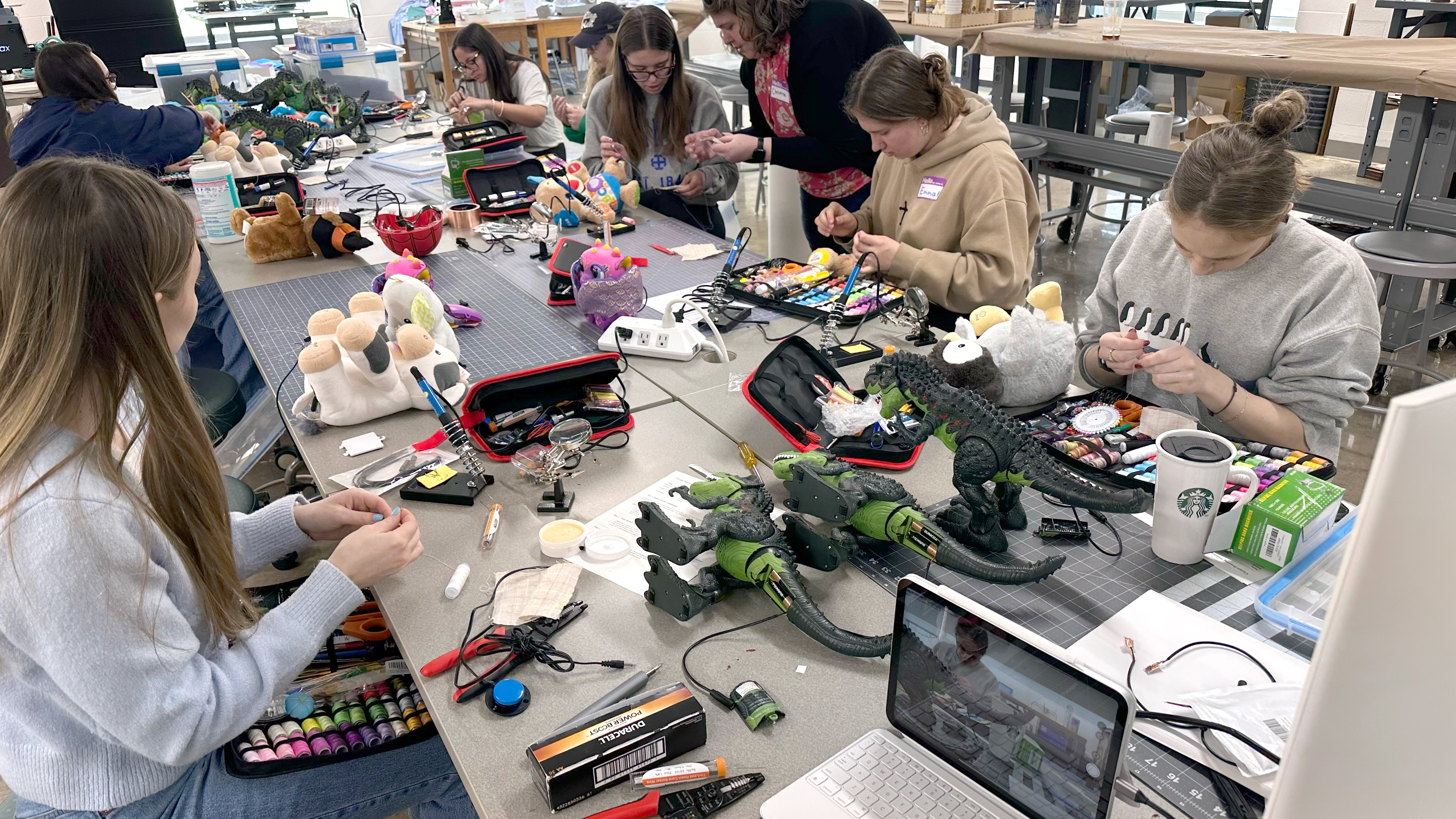
The Spark Lab and SLP have also worked together to adapt toys for children whose physical limitations prevent them from playing conventional toys. In one example, they adapted a motorized stuffed plush toy modifying simple circuitry to create a port, which was then soldered on the toy and enhanced with an adaptive switch. Such devices cost around $75 in the healthcare marketplace, but the Spark Lab created the prototype for under $10.
These successes prompted SLP to organize a variety of workshops to teach industry professionals these new, adaptive methods. For one particular workshop, organizers were pleased to have approximately 40 students attend. This learning model is now evolving into similar workshops for the community.
Recently, the Spark Lab is also working with the mother of a wheelchair-bound, nonverbal child and the SLP department to adapt a toy by raising lower controls of the toy to the appropriate height, allowing the child to use his head mounted stylus and control the toy’s movement. “We are really proud that we are able to witness one of our adaptive devices being used in real time,” Shrestha said.
Since it opened in May 2023, more than 4,000 different products and items have been produced by makers in the Spark Lab. These include a 3D printed protein model, an adapter for a wind measuring tool, models particle accelerator, an enhanced model of a prosthetic leg, 19-foot tall stage backdrop panels for a conference, as well as centerpieces, pen holders, holiday-themed items, Saint Mary’s branded merch, and much more.
“This is a versatile space,” Shrestha said. “There are so many practical ways to use the Spark Lab.” His multipronged approach involves teaching, designing, and operating the machines. “The thing I like about teaching is getting to help people. They come in with ideas and we problem-solve with them to create the product.”
There are so many practical ways to use the Spark Lab. The thing I like about teaching is getting to help people. They come in with ideas and we problem-solve with them to create the product.
- Shreejan Shrestha
Shrestha also gives tours of the Spark Lab to the Avenue 101 classes, required for first-year students, to show them the array of resources available to them. Shrestha gives the students an overview of the numerous capabilities of the Spark Lab and how it can help them with academic assignments or personal passion projects.
The SPARK Business Accelerator is a program within the Division for Belonging that assists local women entrepreneurs in launching or expanding their own businesses. The program recently enrolled its 21st cohort, and though separate from the Spark Lab as of right now, Shrestha said their goals complement each other.
“We help entrepreneurs in the SPARK program by providing technical skills and other assistance,” Shrestha said. “If an entrepreneur’s idea is product-based—if they need a prototype or replica—that’s where we come in. The program and the lab’s dual goals of helping women entrepreneurs mirrors the College’s vision for empowering and expanding opportunities for women.”
For those who are interested in taking prototyping to a higher level, creating on their own, microcredential classes are available, Shrestha added. With the help of faculty co-leads, Jeff Greiner and Michaela Duffy, the lab has developed several microcredentials including 3D printing, basic 3D modeling, and graphic design. For instance, the Graphic Design Beginners microcredential teaches users how to create a design digitally and in turn apply it to create products like posters, sweatshirts or even laser cut items. According to Shrestha, the Spark Lab is building tiers of microcredentialing so a user can master one skill level then move on to the next.
To improve the efficiency and experience of the lab for users as well as staff, a recent $100,000 grant will allow Shrestha to outfit the lab with acoustic panels to improve the sound dynamics in the space. In addition, the larger, louder machines will soon relocate to an enclosed adjacent room. “Our hope is these changes would make the lab a third space on campus and even more appealing for people to spend time here and innovate,” Shrestha said.
The Spark Lab is largely responsible for generating its own revenue, he added. To date, the lab has been able to cover at least 80 percent of its operating budget. Shrestha has future plans for revenue, including a pop-up shop and the creation of unique merchandise.
October 20, 2026