


In The Spotlight: Andrew Pierce
By LISA KNOX
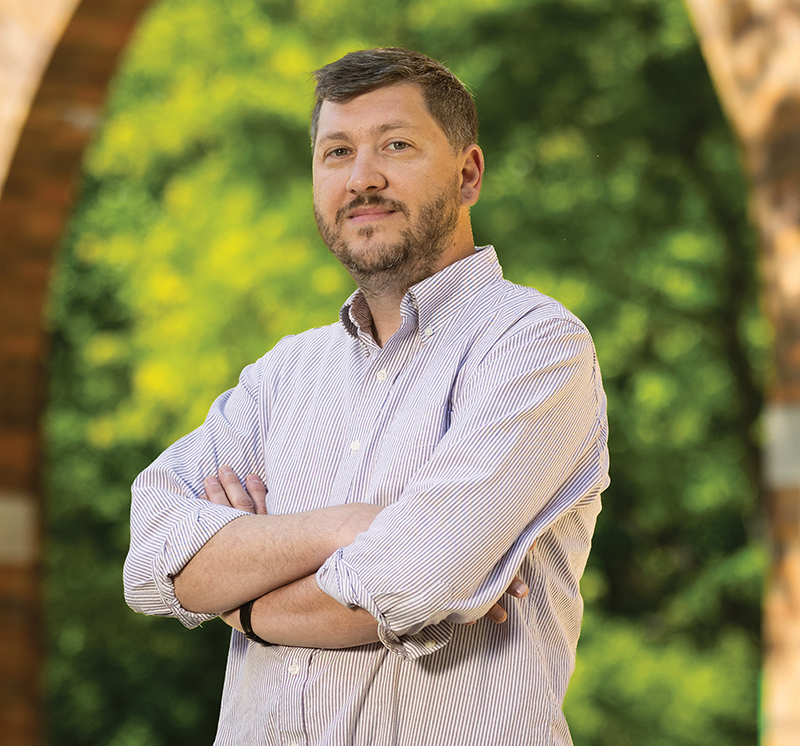
Associate Professor Andrew Pierce is the chair of the Department of Philosophy and the Director of Justice Studies. A community justice advocate, Pierce finds moments of peace in family, travel, and a little hobby known as bonsai.
I took my first philosophy course at a community college near my hometown in Monroe, Michigan. I was probably halfway through the course when I decided I wanted to be a philosophy professor. Both the depth and the breadth of inquiry that philosophy entails fascinated me. I could explore social and political issues, ethics, art, history, and so much more. When I transferred to Michigan State, I majored in philosophy, and then went on to earn my master’s and PhD, specializing in social and political philosophy. I see it as a tool to make a difference in the world.
I recently devised a first-year seminar on public philosophy. I want students to see that philosophy is not just this abstract exercise, but it’s something that’s alive and can actually help people solve pressing problems in the world. A lot of people read and teach Plato, Aristotle, and other philosophers as a kind of an intellectual history, but these historical thinkers can be really helpful for thinking through contemporary problems.
I’ve been reading and thinking about restorative justice for several years now. It’s both a scholarly field and a practice aiming to find productive and non-violent ways of resolving conflicts—everything from interpersonal conflict to crime to these huge, society-wide explosions of violence and war.
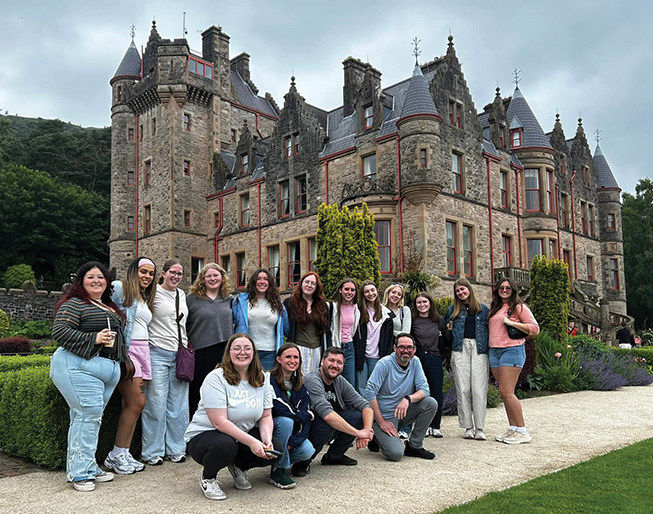
This summer, I led 14 students on an eight-day intensive service trip to Northern Ireland where we focused on the sectarian conflict known as the Troubles. We studied restorative justice practices in the neighborhoods of Belfast, which aim to create nonviolent alternatives to the punishment violence enacted by paramilitary groups. We talked with ex-combatants and political prisoners about their experiences. We volunteered in both Catholic and Protestant youth centers, seeing how the legacy of the conflict still shapes the lives of young people today. It was a profound learning experience that provided a wealth of insight to be applied to our own contemporary divisions and conflicts.
There’s an appetite for restorative justice among young people. This summer, I also led the Dialogue and Democracy Institute for pre-college students, a program for high schoolers who want to engage with each other across political differences, cultural differences, and experiential differences. In this program, we focused not only on dialogue but also on civic engagement—how we can take this skill of dialogue across differences and use it to actually make change. We teach people to be curious about the rights and viewpoints of others.
When I ask my students their top concerns, housing is always up there. This generation often doesn’t see home ownership as a realistic goal, and some even feel renting is out of their reach because it has become so expensive. It’s something they’re worried about, so it’s nice to be able to connect that concern to what’s happening in the community. At Saint Mary’s, we have the Katherine T. Dooley Social Justice Fellowship that helps students develop leadership skills addressing a social justice issue that matters deeply to them. Last year, the selected fellows focused on affordable housing.
Indiana is one of the worst states for tenant law, while South Bend has some of the highest eviction rates in the country. Students met with folks in the community—Housing as a Human Right, the NAACP, the Volunteer Lawyers Network and others. We spent most of our time in eviction court observing and collecting data for the Indiana Eviction Justice Network. This group is trying to figure out why local eviction rates are so high. Our students tracked the length of the hearings, demographics, and whether the tenants and landlords had legal representation. They learned a lot, and were able to do some good, too. Our project was able to update some of the rental assistance resources that volunteer lawyers provide to tenants.
At the college level, we’ve seen a change in students who are majoring in philosophy, not necessarily wanting the traditional path through grad school and a PhD, but rather using it as a foundation for a different kind of career. Students today are using their philosophy degree in everything from education to healthcare. It’s why we’re seeing more diverse groups of students—racially, economically, culturally—pursuing philosophy.
Philosophy is still a male-dominated discipline, so it’s been fun to work at a place where women’s voices are prioritized. It’s empowering to have a classroom of women who are able to showcase their voices and confidence. I’ve taught at co-ed institutions, and what is different about working at Saint Mary’s is the students here tend to approach philosophy in a more collaborative way rather than as this kind of intellectual warfare.
I have a natural curiosity about different places, different people, different ways of life—just going to a place and being immersed in a totally different way of being. It’s philosophical in a sense. I went on my first overseas trip when I was in high school. I went to France, and I was hooked. I went on sabbatical in Peru in 2022 for three months; my wife and 1-year-old son were with me. It was a really cool experience. We’ve been to China, Japan, and a bunch of places in Europe. Our two kids were with us this summer in Northern Ireland. Travelling together as a family has been a new and rewarding experience.
During COVID, I discovered a little flower shop near my hometown that has a bonsai expert. I had been interested in bonsai for a while, but during that time I really got into it. Now I have something like 30-40 trees in my backyard. It’s an interesting mix of gardening and art, expressing one’s creativity through a living, evolving thing. I love to see how the trees develop, and how different techniques produce dramatically different results. ‖